
Online Chemistry Tutor
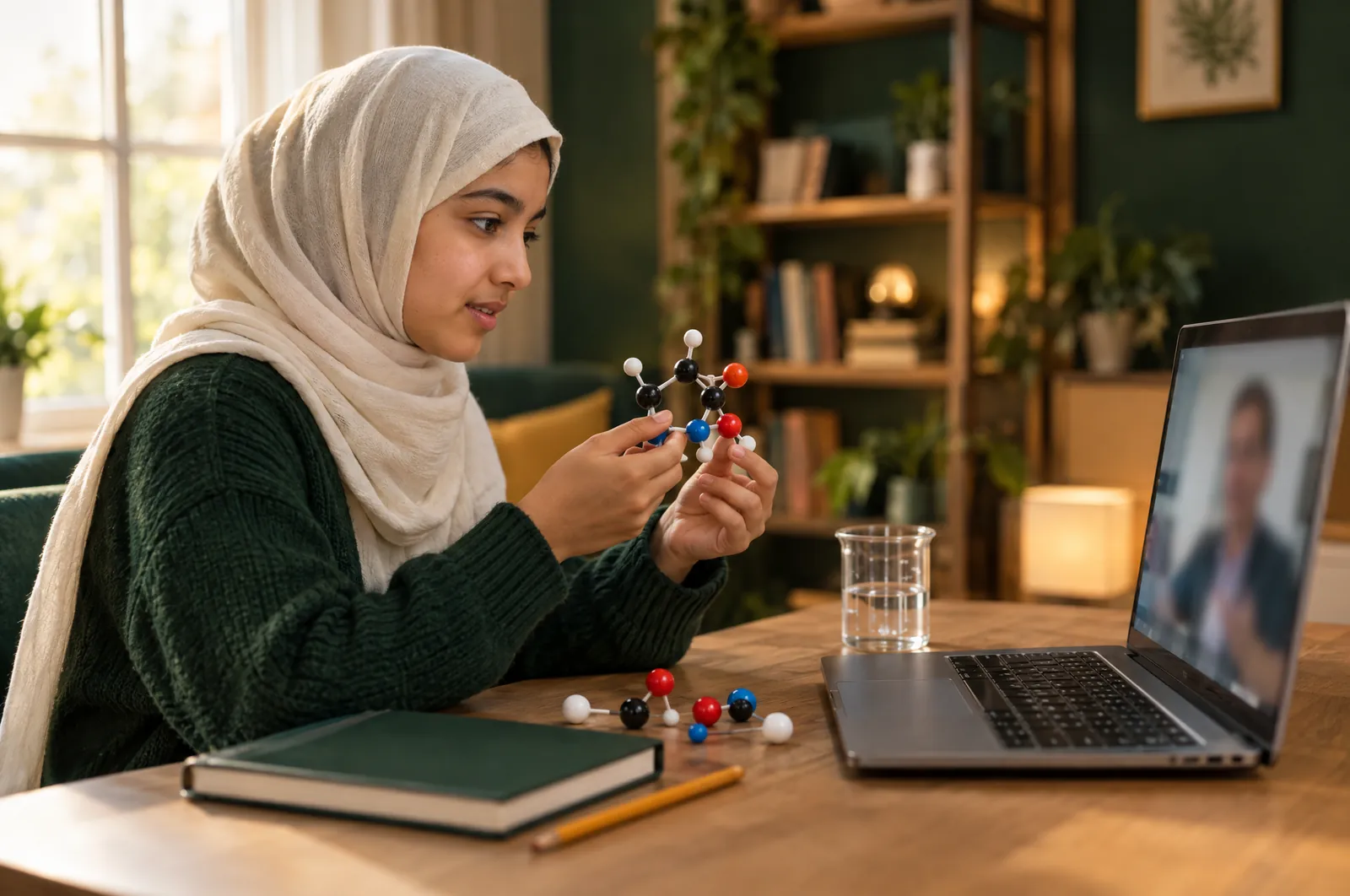
An online chemistry tutor from OnlineQuran24 teaches one student at a time in a live 60-minute video lesson, working from the student’s own syllabus, homework and past papers. Middle school, high school, GCSE, A-Level and AP students use these lessons to rebuild weak foundations, master calculations and prepare for exams.
- 1-on-1 live chemistry lessons
- 60 minutes per lesson
- 24/7 scheduling for any time zone
- 3-day free trial before paying
What does an online chemistry tutor help with?
An online chemistry tutor explains the concepts a student finds difficult, checks the reasoning behind each answer and trains the student to solve exam-style questions without help. The tutor works from the student’s own course, so the class follows the same order and vocabulary as school.
Students arrive with different goals. A high school chemistry student often needs help with moles and balancing equations before a unit test. A GCSE chemistry student usually needs structured revision across the whole specification and practice with six-mark answers. An A-Level chemistry student typically needs depth in organic mechanisms, equilibrium constants and energetics. Share the course name and exam board (for example AQA, Edexcel, OCR, Cambridge IGCSE or AP Chemistry) on WhatsApp, and the class plan is built around it.
Which chemistry topics does the tutoring cover?
Chemistry tutoring covers the five areas that appear in almost every school chemistry course, from the structure of the atom to carbon chemistry. Each area builds on the one before it, so the tutor checks the earlier idea first when a later topic feels confusing.
Atomic structure and the periodic table
Protons, neutrons and electrons, isotopes, electron configuration and periodic trends. Students learn why atomic radius decreases across a period and why ionization energy increases, instead of memorizing the trend alone.
Bonding and structure
Ionic, covalent and metallic bonding, dot-and-cross diagrams, molecular shapes and intermolecular forces. The tutor links each bond type to properties such as melting point and electrical conductivity.
Moles and stoichiometry
Relative formula mass, the mole, the Avogadro constant, concentration, gas volumes, limiting reagents and percentage yield. This is the calculation core of chemistry.
Reactions, energetics and equilibrium
Acids and bases, redox, electrolysis, rates of reaction, enthalpy changes and reversible reactions. Students apply Le Chatelier’s principle to predict how temperature, pressure and concentration shift an equilibrium.
Organic chemistry
Homologous series, functional groups, naming, isomers and reaction mechanisms. Organic chemistry help starts with alkanes and alkenes and extends to alcohols, carboxylic acids and esters at higher levels.
How does a chemistry tutor make mole calculations clear?
A chemistry tutor makes mole calculations clear by teaching one fixed method and repeating it until the student applies it without prompting. The mole is the amount of substance that contains 6.02 × 10²³ particles, and most stoichiometry questions reduce to the relationship moles = mass ÷ molar mass.
The tutor demonstrates the method on a short example, such as finding how many moles are in 4.4 g of carbon dioxide (molar mass 44 g/mol, so 0.1 mol), and then the student solves the next three questions aloud while the tutor listens for the exact step where the reasoning breaks.
- Write a balanced equation and check that atoms balance on both sides.
- Convert the given quantity (mass, volume or concentration) into moles.
- Use the mole ratio from the equation to find moles of the target substance.
- Convert back to the unit the question asks for, with correct significant figures.
How is organic chemistry taught in a 1-on-1 online class?
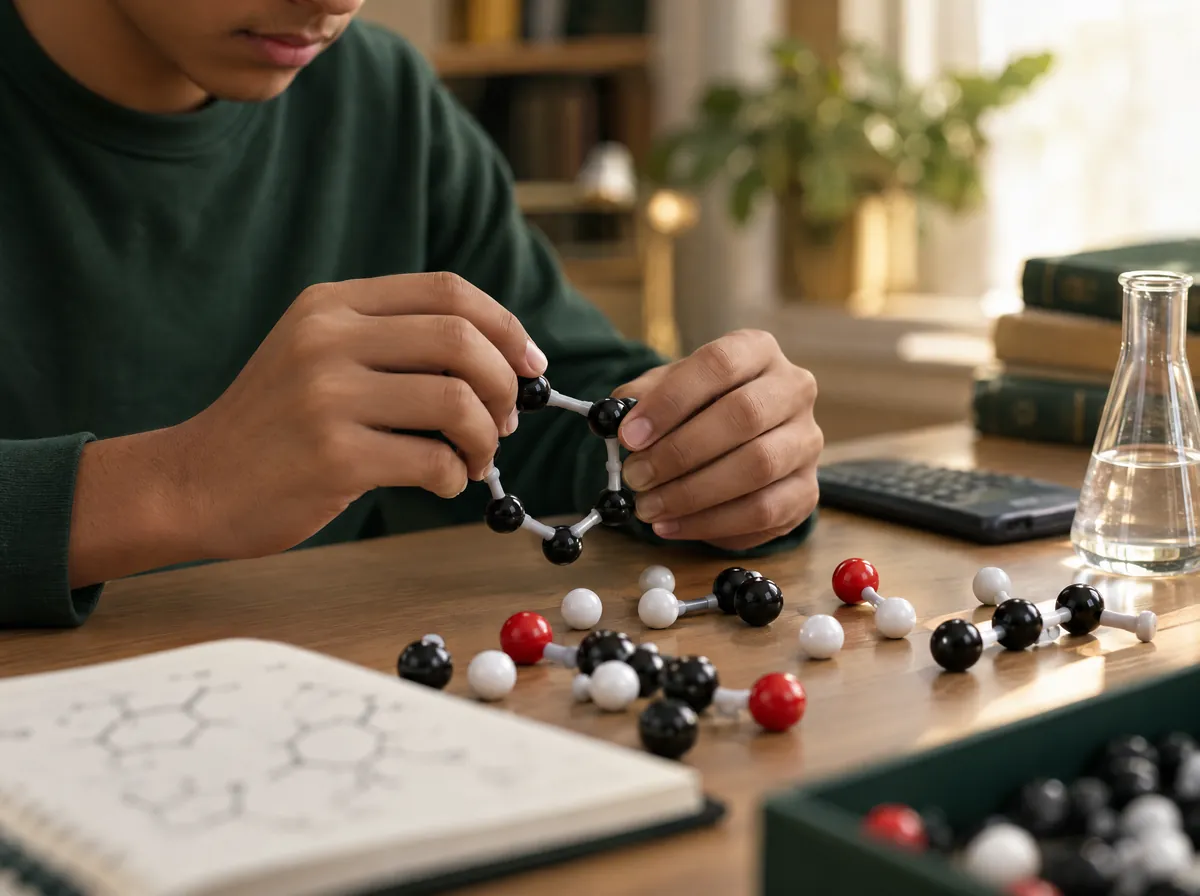
Organic chemistry is taught online by drawing structures and mechanisms on a shared screen, step by step, while the student copies and then reproduces them independently. Organic chemistry rewards pattern recognition: once a student identifies the functional group, the likely reactions follow.
- Naming: students build IUPAC names from the longest carbon chain, the functional group and the position numbers.
- Isomers: students draw structural isomers and, at A-Level, identify E/Z and optical isomers.
- Mechanisms: curly arrows show the movement of an electron pair; students practice electrophilic addition and nucleophilic substitution until every arrow starts at a lone pair or a bond.
- Reaction maps: students connect alkanes, alkenes, alcohols, aldehydes and carboxylic acids on one page, with the reagent and condition for each step.
Can practical chemistry skills be learned online?
Practical chemistry skills are learned online at the conceptual level: students study the method, the variables, the measurements and the sources of error, and they answer the written practical questions that exams set. Students do not carry out experiments with chemicals at home during class.
For a titration, the tutor explains why the burette is read at the bottom of the meniscus, how concordant results are chosen and how to calculate an unknown concentration. For a rates investigation, the student identifies the independent, dependent and control variables. For chromatography, the student calculates an Rf value as the distance moved by the spot divided by the distance moved by the solvent. Many written exam marks come from this reasoning, so the online format suits it well.
What happens in a 60-minute chemistry lesson?
A 60-minute chemistry lesson follows a fixed structure: a recall check, one focused concept, guided practice and independent exam-style questions. The structure keeps every lesson active rather than a lecture.
- Minutes 0–10: recall questions on the previous lesson and a homework check.
- Minutes 10–30: one concept taught with worked examples.
- Minutes 30–50: the student solves exam-style questions while explaining each step.
- Minutes 50–60: questions without help, then a short homework task.
Parents can sit in on a child’s class at any time. Families choose a male or female teacher, and girls can study with a female teacher only.
How does chemistry tutoring improve exam technique?
Chemistry tutoring improves exam technique by teaching students what each command word demands and how marks are awarded. A student who understands the chemistry still loses marks by describing when the question says explain, or by leaving out units.
- State needs a fact; describe needs what happens; explain needs why it happens.
- Calculate questions award method marks, so every step is written down.
- Answers carry units and the significant figures given in the data.
- Past paper answers are marked against the official mark scheme in class.
Chemistry overlaps with other sciences: cellular respiration and enzymes link to online biology tutoring, and energy, particles and electricity link to online physics tutoring.
How much does an online chemistry tutor cost?
Online chemistry tutoring costs $88–$128 a month for 8 live 60-minute lessons, depending on level. Each plan is a monthly package of 2 lessons a week, a 3-lessons-a-week option lowers the price per lesson, and the price stays well below typical UK and US private tutor rates while every lesson remains live and 1-on-1.
Middle school / KS3 chemistry
Grades 6–8 · KS3 · particles, atoms, simple reactions
$88 / month
£62 · C$114 · $11 per lesson
- 8 live 60-minute 1-on-1 lessons a month
- 3 lessons/week: $121/month (£85 · C$157)
- Male or female tutor
- Follows your school science course (tell us your curriculum)
- Scheduled in your time zone, 24/7
Most popular
GCSE / High school chemistry
Grades 9–10 · GCSE (all boards) · bonding, moles, reactions
$104 / month
£73 · C$135 · $13 per lesson
- 8 live 60-minute 1-on-1 lessons a month
- 3 lessons/week: $144/month (£101 · C$187)
- Follows your exam board: AQA, Edexcel, OCR, IGCSE or US high school (tell us your curriculum)
- Male or female tutor, 24/7 scheduling
- 3-day free trial before paying
A-Level & AP Chemistry
Grades 11–12 · A-Level, AP Chemistry · organic, equilibria
$128 / month
£90 · C$166 · $16 per lesson
- 8 live 60-minute 1-on-1 lessons a month
- 3 lessons/week: $177/month (£124 · C$230)
- Follows your A-Level board or AP Chemistry course (tell us your curriculum)
- Male or female tutor
- Scheduled in your time zone, 24/7
Choose the level that matches the student’s current course, and pick 3 lessons a week in the months before exams. The tutoring and Quran class fees page compares prices for every subject, and the online academic tutoring hub lists all subjects taught.
Chemistry tutoring FAQs
Which levels of chemistry do you teach?
Classes cover school chemistry, including middle school, high school, GCSE, IGCSE, A-Level and AP Chemistry courses. Share the exact course on WhatsApp to confirm the class plan.
How much does online chemistry tutoring cost?
Online chemistry tutoring costs $88 a month for middle school / KS3, $104 for GCSE / high school and $128 for A-Level and AP Chemistry, each for 8 live 60-minute lessons (2 a week). With 3 lessons a week, the prices are $121, $144 and $177 a month. Every student starts with a 3-day free trial.
Is a 60-minute lesson the right length for chemistry?
Yes. A 60-minute lesson leaves time to teach one concept, work through examples and practice exam-style questions, and students book 2 or 3 lessons a week to cover a full course steadily.
What happens during the 3-day free trial?
The trial classes check the student’s current level with short questions, identify weak topics and show how lessons run before any payment.
Can my daughter learn chemistry with a female teacher?
Yes. Families choose a male or female teacher, and girls can study with a female teacher only.
What does a student need for an online chemistry class?
A laptop or tablet with a camera, a stable internet connection, a notebook, a calculator and the school textbook or syllabus. A molecular model kit is optional.
Do you offer chemistry classes in my time zone?
Yes. Classes run 24/7, so students in the US, UK, Canada, Europe, the Middle East and Australia book times after school or on weekends.
Start with an online chemistry tutor this week
Send the student’s level and exam board on WhatsApp, book the 3-day free trial and get a clear plan for the chemistry topics that need work.