The Complete Guide to Online Quran Classes for Kids 2026
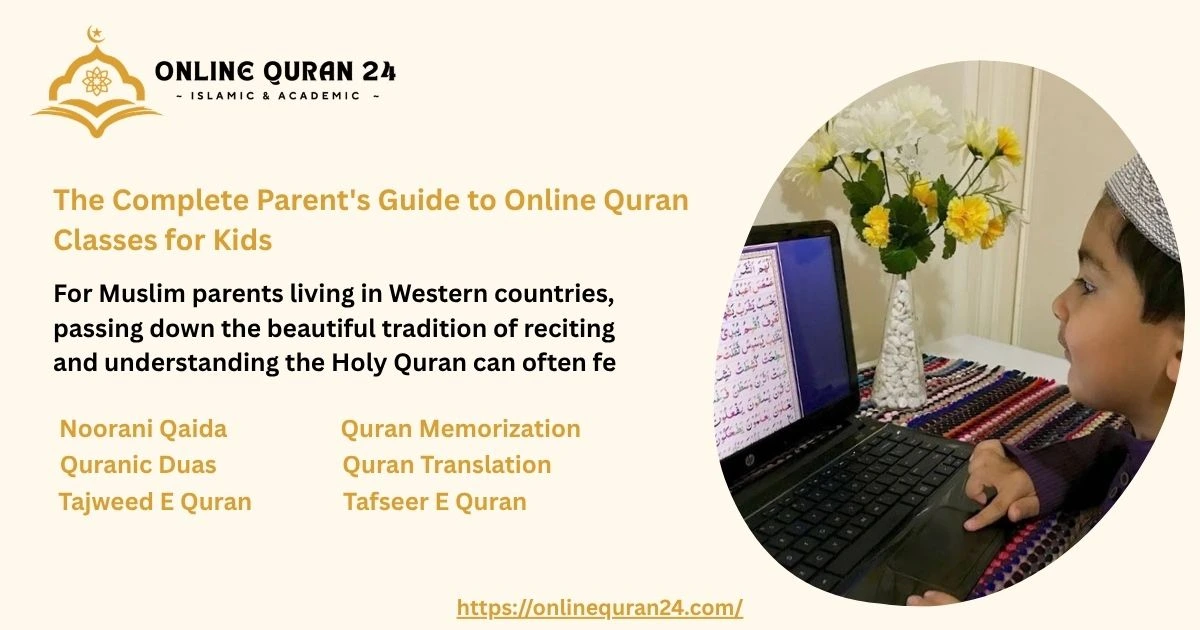
The Complete Parent’s Guide to Online Quran Classes for Kids For Muslim parents living in Western countries, passing down the beautiful tradition of reciting and
Read More »

As parents, our deepest instinct is to protect our children. We childproof our homes, ensure they eat healthy foods, and hold their hands when crossing the street. But as Muslim parents, we know that true protection extends beyond the physical world; it encompasses the spiritual and emotional well-being of our families.
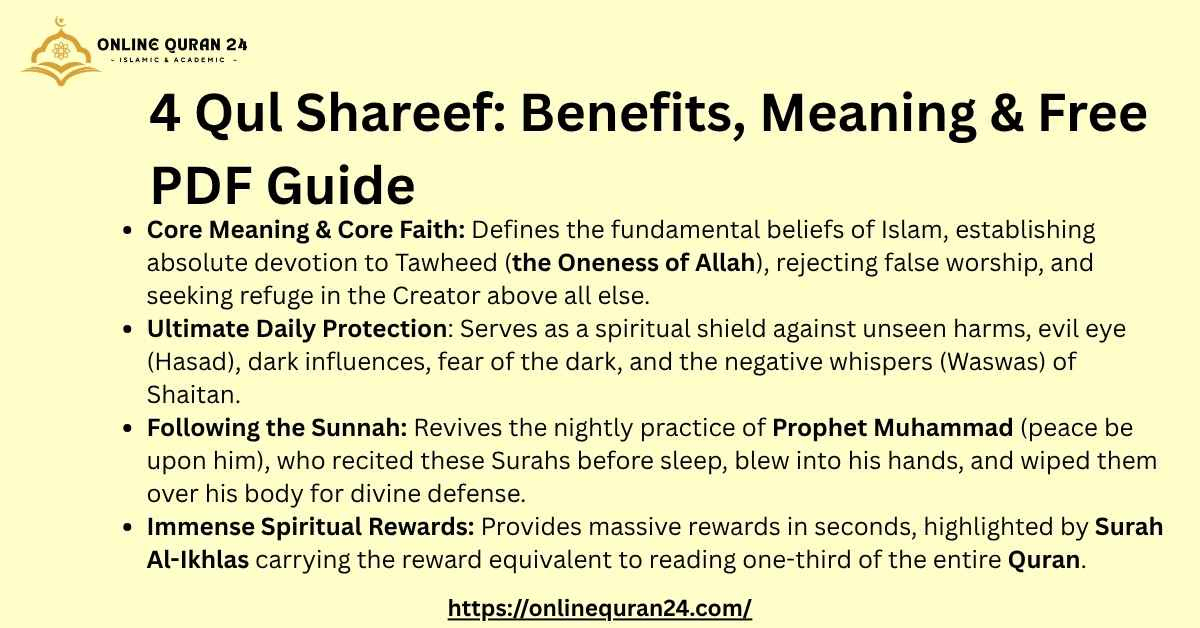
One of the most profound gifts given to the Prophet Muhammad (Peace Be Upon Him) for spiritual protection is the 4 qul shareef. These four short but incredibly powerful chapters from the Holy Quran serve as a shield against harm, evil eyes, whispers of doubt, and negativity.
For Muslim families living in the United States, the United Kingdom, Canada, Australia, and beyond, passing down the habit of reciting these Surahs is a fundamental part of Islamic parenting. Whether you are looking for a clear 4 qul pdf to help your child with pronunciation, or you simply want to understand how to explain these profound verses to a seven-year-old, this guide is designed for you.
Let us explore the meanings, benefits, and practical ways to weave the Char Qul into your family’s daily routine.
The Arabic word “Qul” translates directly to “Say” or “Declare.” The 4 Qul surah collection refers to four distinct chapters toward the very end of the Quran that open with this commanding verb. When Allah uses the word “Qul,” it is a direct divine instruction to Prophet Muhammad (peace be upon him)—and by extension, to all Muslims—to boldly declare the words that follow.
These four chapters encapsulate the very essence of the Islamic faith. They draw clear boundaries between belief and disbelief, define the absolute oneness of Allah (Tawheed), and provide a powerful shield of spiritual protection against both physical and unseen harms. Because of their brevity and their rhythmic phonetic structure, the 4 quls in quran are incredibly accessible for young children and new Muslims alike, making them a cornerstone of foundational Islamic studies.
Before diving into the detailed exegesis (Tafseer), it is important to familiarize ourselves with the specific names and placements of these chapters within the Holy Quran. The 4 Quls names are:
Surah Al-Kafirun (Chapter 109)
Surah Al-Ikhlas (Chapter 112)
Surah Al-Falaq (Chapter 113)
Surah An-Nas (Chapter 114)
The final two chapters, Surah Al-Falaq and Surah An-Nas, are also historically grouped together under the title Al-Mu’awwidhatayn, which translates to “The Verses of Refuge.”
To truly benefit from the 4 quls in quran, we must understand their meanings. Children memorize better when they understand the story and purpose behind the Arabic words. Here is a breakdown of each 4 Qul Shareef and how you can easily explain it to your children.
Theme: Absolute clarity in faith and the rejection of polytheism.
Historically, this Surah was revealed in Makkah during a period when the leaders of the Quraysh attempted to negotiate a religious compromise with the Prophet Muhammad (peace be upon him). They proposed that they would worship Allah for one year if the Prophet would worship their idols for the next. This Surah was revealed as a definitive, uncompromising rejection of that proposal.
بِسْمِ اللّٰهِ الرَّحْمٰنِ الرَّحِیْمِ
قُلْ يَـٰٓأَيُّهَا ٱلْكَـٰفِرُونَ (١) لَآ أَعْبُدُ مَا تَعْبُدُونَ (٢) وَلَآ أَنتُمْ عَـٰبِدُونَ مَآ أَعْبُدُ (٣) وَلَآ أَنَا۠ عَابِدٌۭ مَّا عَبَدتُّمْ (٤) وَلَآ أَنتُمْ عَـٰبِدُونَ مَآ أَعْبُدُ (٥) لَكُمْ دِينُكُمْ وَلِىَ دِينِ (٦)
“Bismillahir-Rahmanir-Raheem
Qul ya ayyuhal-Kafiroun
La ‘a-budu ma ta’-bu-doun
Wa la antum ‘abidouna ma ‘a-bud
Wa la ana ‘abidum-ma ‘abadttum
Wa la antum ‘abiduna ma ‘a-bud
Lakum deenukum wa li-ya deen”
Say, “O disbelievers,
I do not worship what you worship.
Nor are you worshippers of what I worship.
Nor will I be a worshipper of what you worship.
Nor will you be worshippers of what I worship.
For you is your religion, and for me is my religion.”
Despite its brevity, the Prophet (PBUH) stated that reciting Surah Al-Ikhlas is equivalent to reading one-third of the entire Quran. It is the purest definition of Allah.
The Core Message: Allah is One, He is eternal, He was not born, He does not have children, and there is absolutely nothing in the universe comparable to Him.
How to explain it to a child: Ask your child to imagine the strongest, most unique thing they can think of. Then explain, “Allah is greater than that. He created everything, but nobody created Him. When we read this Surah, we are telling Allah how special and perfect He is.”
بِسْمِ اللّٰهِ الرَّحْمٰنِ الرَّحِیْمِ
قُلْ هُوَ ٱللَّهُ أَحَدٌ (١) ٱللَّهُ ٱلصَّمَدُ (٢) لَمْ يَلِدْ وَلَمْ يُولَدْ (٣) وَلَمْ يَكُن لَّهُۥ كُفُوًا أَحَدٌۢ (٤)
Bismillahir-Rahmanir-Raheem
Qul Huwa-llahu ‘Ahad
Allahus-Samad
Lam Yalid Wa Lam Yulad
Walam Yakul-La-Hu-Kufuwan ‘Ahad “
Say, “He is Allah, [who is] One,
Allah, the Eternal Refuge.
He neither begets nor is born,
Nor is there to Him any equivalent.”
The third of the 4 quls in quran focuses on seeking protection from external harms that exist in the world, especially those hidden in darkness.
The Core Message: We seek refuge in the Lord of the dawn from the evil of what He has created, the evil of darkness, the evil of those who practice magic, and the evil of the envious.
How to explain it to a child: Say, “Sometimes the dark can feel scary, or sometimes people can be unkind. This Surah is like a magical invisible shield. When you read it, Allah acts as your protector from anything outside that might try to hurt you.”
بِسْمِ اللّٰهِ الرَّحْمٰنِ الرَّحِیْمِ
قُلْ أَعُوذُ بِرَبِّ ٱلْفَلَقِ (١) مِن شَرِّ مَا خَلَقَ (٢) وَمِن شَرِّ غَاسِقٍ إِذَا وَقَبَ (٣) وَمِن شَرِّ ٱلنَّفَّـٰثَـٰتِ فِى ٱلْعُقَدِ (٤) وَمِن شَرِّ حَاسِدٍ إِذَا حَسَدَ (
Bismillahir-Rahmanir-Raheem
Qul ‘A’udhu Bi-Rabbil-Falaq
Min Sharri Ma Khalaq
Wa Min Sharri Ghasiqin ‘Idha Waqab
Wa Min Sharri-Naffathati Fil-‘Uqadi
Wa Min Sharri Hasidin ‘Idha Hasad
Say, “I seek refuge in the Lord of daybreak
From the evil of that which He created
And from the evil of darkness when it settles
And from the evil of the blowers in knots
And from the evil of an envier when he envies.”
While Al-Falaq protects us from outside harm, An-Nas protects us from inside harm—specifically, the whispers and doubts planted by Shaitan (Satan) in our own hearts and minds.
The Core Message: We seek refuge in the Lord, the King, and the God of mankind, from the whispering evil that tries to make us do wrong or feel anxious.
How to explain it to a child: Tell your child, “Have you ever had a little voice in your head telling you to be mean to your sibling or telling you that you aren’t good enough? That is a bad whisper. Surah An-Nas makes those bad whispers go away and fills your heart with peace.”
بِسْمِ اللّٰهِ الرَّحْمٰنِ الرَّحِیْمِ
قُلْ أَعُوذُ بِرَبِّ ٱلنَّاسِ (١) مَلِكِ ٱلنَّاسِ (٢) إِلَـٰهِ ٱلنَّاسِ (٣) مِن شَرِّ ٱلْوَسْوَاسِ ٱلْخَنَّاسِ (٤) ٱلَّذِى يُوَسْوِسُ فِى صُدُورِ ٱلنَّاسِ ٥ مِنَ ٱلْجِنَّةِ وَٱلنَّاسِ (٦)
Bismillahir-Rahmanir-Raheem
Qul ‘A’udhu Bi-Rabbin-Nas
Malikin-Nas
Ilahin-Nas
Min-Sharril-Waswasil-Khan-Nas
Al-Ladhi Yuwas-wisu Fee Sudurin-Nas
Mina Al-Jinnati Wan-Nas
Say, “I seek refuge in the Lord of mankind,
The Sovereign of mankind.
The God of mankind,
From the evil of the retreating whisperer –
Who whispers [evil] into the breasts of mankind –
From among the jinn and mankind.”
The Importance of Daily Recitation of the 4 Qul cannot be overstated in Islamic tradition. These chapters are not meant to simply sit on a shelf; they are designed to be active, daily spiritual armor.

One of the most beautiful traditions you can establish with your children is the bedtime recitation. According to authentic Hadith, every night before sleeping, the Prophet (PBUH) would cup his hands together, blow gently into them, and recite Surah Al-Ikhlas, Surah Al-Falaq, and Surah An-Nas. He would then wipe his hands over whatever he could reach of his body, starting with his head and face. He would do this three times.
As parents, doing this with your young children, and eventually teaching them to do it independently, provides immense comfort. It helps kids who struggle with night terrors or fear of the dark realize that Allah is actively watching over them.
The most highly emphasized time to recite the Char Qul (specifically the last three) is immediately before going to sleep. Authentic traditions (Ahadith) narrate that the Prophet Muhammad (peace be upon him) would cup his hands together every night, recite Surah Al-Ikhlas, Surah Al-Falaq, and Surah An-Nas, blow gently into his hands, and then wipe his hands over whatever he could reach of his body, starting from his head and face. He would repeat this process three times.
For parents, establishing this physical and spiritual routine with young children fosters a deep sense of bedtime security.
Reciting these Surahs is a vital component of the prescribed morning and evening prayers (Adhkar). Reciting them three times in the morning and three times in the evening is said to be sufficient to protect a person from all forms of harm throughout the day and night.
The latter two Surahs (Al-Falaq and An-Nas), known collectively as the Mu’awwidhatayn (the verses of refuge), were heavily recited by the Prophet (PBUH) when he was ill. When your child feels unwell or anxious, reciting these Surahs over them is a profound act of parental love and Islamic tradition.
Before embarking on the recitation of the Char Qul, teach your child to recite Tauz (Ta’awwudh). Saying “A’udhu billahi minash shaitanir rajim” (I seek refuge in Allah from the outcast Shaitan) prepares the heart. It is the spiritual key that unlocks the protection of the Surahs that follow. Make it a rule: before we read our Quls, we say our Tauz.
Life is filled with challenges. The Quran frequently reminds believers of the principle fa inna ma al usri yusra (“For indeed, with hardship [will be] ease”). Reciting the 4 Qul shareef, particularly Surah Al-Ikhlas, refocuses a worried mind entirely on the greatness of Allah. When believers internalize that Allah is the Eternal Refuge, their worldly anxieties naturally shrink, paving the way for the promised ease.
In our modern, fast-paced world, having accessible, well-formatted learning materials is incredibly helpful. Many families seek out a 4 qul pdf to streamline their children’s Islamic education. Here is how a dedicated PDF document enhances learning:
Distraction-Free Environment: Unlike browsing web pages filled with notifications, a downloaded char qul pdf provides a clean, focused document.
Printability: Parents can print the document, laminate it, and place it near a child’s bedside or in their designated prayer area as a constant visual reminder.
Accessibility for Beginners: High-quality PDFs often include color-coded Tajweed rules, making it significantly easier for students to identify where to elongate vowels and how to pronounce difficult letters.
For families living in the United States, the UK, Canada, and Australia, Arabic is often a second or third language. A 4 Qul Shareef Transliteration PDF bridges this linguistic gap. Transliteration uses the English alphabet to spell out the phonetic sounds of the Arabic words.
While the ultimate goal of any quran memorization journey should be reading the original Arabic script, transliteration serves as an excellent, confidence-building stepping stone for beginners and young children ensuring they can begin experiencing the spiritual benefits immediately.
The 4 Qul Shareef serves as a beautiful, powerful gateway into the lifelong journey of understanding the Quran. By establishing a routine of daily recitation, discussing the Tafseer at the dinner table, and utilizing helpful resources like a 4 Quls PDF, parents can build a fortress of faith and protection around their families.
However, you do not have to embark on this educational journey alone. Building a strong foundation in Tajweed and precise Quranic pronunciation requires the ear of a trained, patient instructor.
If you want to ensure your child develops a deep, lasting relationship with the Quran, Online Quran 24 is here to help. We offer professional, interactive online Quran classes designed specifically for children and teenagers. Whether your child is starting as a complete beginner with the Noorani Qaida, or is ready to dive into comprehensive Quran memorization and Islamic studies, our expert tutors provide a flexible and supportive environment.
Equip your child with the spiritual tools they need to navigate life with confidence. Join the countless Muslim parents across the US, UK, Canada, and beyond who trust Online Quran 24 for their family’s Islamic education.
Yes, high-quality PDFs are widely available to support your learning journey. You can easily find and download a 4 Qul Shareef PDF that includes the original Arabic text, English translation, and helpful transliteration. Printing these documents is an excellent way to practice daily until you have fully memorized the chapters.
The four chapters are Surah Al-Kafirun (Chapter 109), Surah Al-Ikhlas (Chapter 112), Surah Al-Falaq (Chapter 113), and Surah An-Nas (Chapter 114). They are located at the very end of the Quran and are among the most frequently recited chapters in daily prayers.
The benefits are vast and well-documented in Islamic traditions. Reciting them provides spiritual protection from unseen harm, the evil eye, and the whispers of Shaitan. Furthermore, reciting Surah Al-Ikhlas brings the immense reward of reciting one-third of the entire Quran, reaffirming a believer’s deep faith in the Oneness of Allah.