Physics

Physics Courses Online: Live Tutoring in English and Urdu

Online Quran 24 offers live, one-on-one physics courses online for school and college students, taught in English or Urdu by vetted tutors. In five years, the academy has taught more than 350 students worldwide. Every new physics student can start with a 3-day free trial before committing to regular classes.

At a glance:

  • Live 1-on-1 physics classes, not group sessions
  • Taught in English or Urdu
  • 350+ students taught over 5 years
  • Students welcomed from anywhere in the world
  • 3-day free trial before any payment

About Our Physics Teachers

What to expect from every tutor at Online Quran 24:

  • A background check and subject-knowledge review before joining the academy
  • Comfortable teaching in both English and Urdu
  • Focused on one student per class, not a group

What Exactly Is Physics?

Physics is the branch of science that studies matter, energy, motion, and the forces that connect them — from why an apple falls to how a rocket reaches orbit. It’s one of the oldest natural sciences, and it forms the foundation for chemistry, engineering, and much of modern technology.

Physics answers everyday questions students already wonder about:

  • Why is the sky blue?
  • How do brakes actually stop a car?
  • Why does a ball fall faster than a feather in air, but not in a vacuum?

At Online Quran 24, each lesson follows the same simple structure:

  1. The tutor explains a concept clearly
  2. A worked example follows
  3. The student practices a similar problem while the tutor watches in real time

Before modern advancements, the physical world was explained through the laws of Classical Physics. The work of Sir Isaac Newton laid the groundwork, introducing principles that describe motion and forces. These laws explain how objects move and interact in everyday life, forming the base of mechanical understanding.

The Historical Pillars of Physical Science

Physical science didn’t arrive in one moment — it built up over centuries, through a small number of thinkers whose ideas still shape how physics is taught today.

  • Aristotle (Ancient Greece) – one of the first to try to explain motion and matter through systematic observation, even where his conclusions were later overturned
  • Ibn al-Haytham (Islamic Golden Age, c. 1000s) – tested ideas about light and vision through controlled experiments, an approach that helped shape the modern scientific method
  • Galileo Galilei (early 1600s) – used experiments and measurement to study falling objects and motion, challenging ideas that had stood for centuries
  • Isaac Newton (1687) – published the laws of motion and universal gravitation in the Principia, the basis of classical mechanics
  • Albert Einstein (1905 and 1915) – introduced special and general relativity, reshaping how physicists understand space, time, and gravity

These are the historical pillars of physical science most courses still build on, whether taught online or in a classroom.

Major Branches of Physics Explained

Physics courses online usually work best when broken into clear branches, so a student knows what they’re building toward. The major branches of physics explained simply:

  • Mechanics – motion, forces, and energy: why things move, and what makes them stop
  • Thermodynamics – heat, temperature, and energy transfer
  • Electromagnetism – electricity, magnetism, and how the two relate
  • Optics – how light behaves, reflects, and refracts
  • Waves and Sound – vibrations, frequency, and how sound travels
  • Astrophysics – how physics explains stars, planets, and the wider universe
  • Modern/Quantum Physics – the physics of atoms, particles, and the very small

A well-structured course starts with mechanics and basic measurement, then builds toward the more abstract branches as a student’s math skills grow.

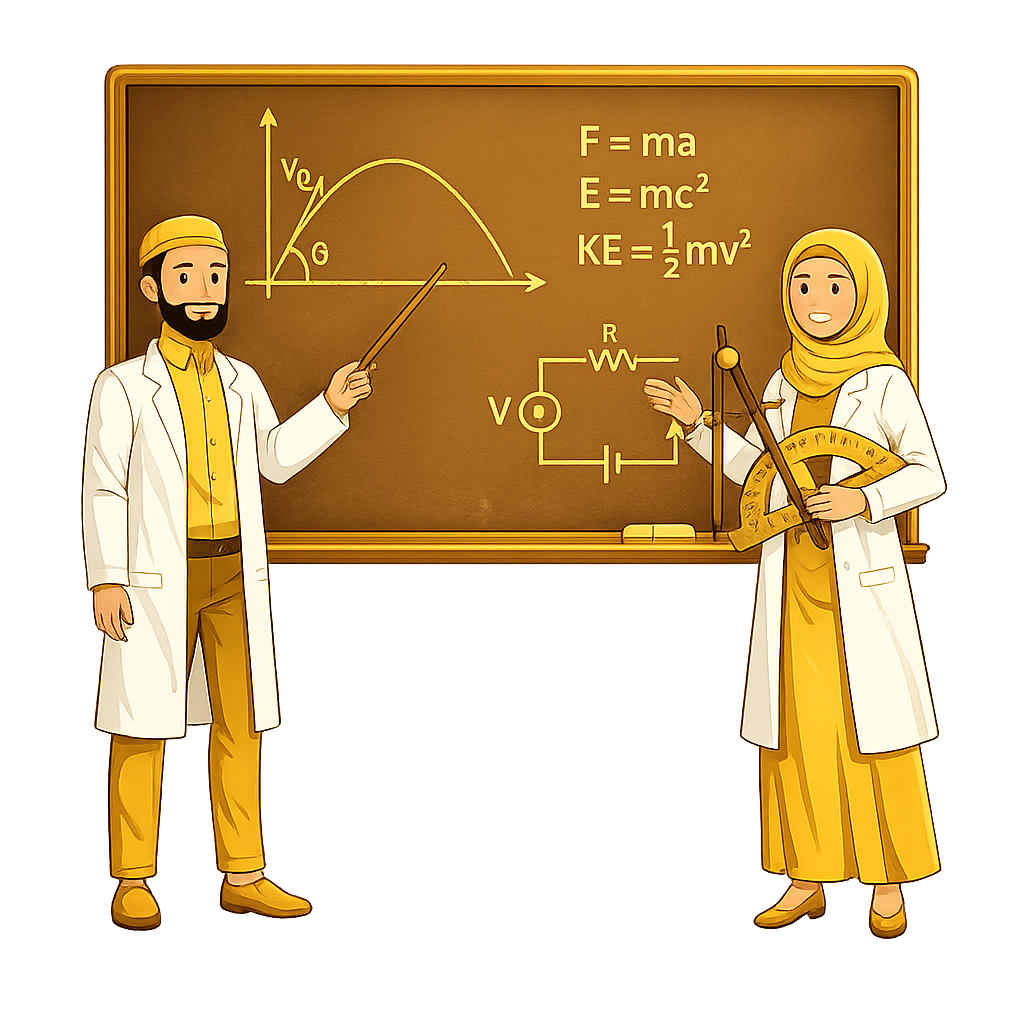
A dedicated student solving complex physics equations on a large classroom whiteboard.

Real-World Applications of Physics

Physics isn’t only theory — it shows up in tools and technology students already use every day:

  • Medicine – X-rays and MRI scans rely directly on physics
  • Engineering – bridges, buildings, and vehicles are designed using mechanics and materials physics
  • Technology – smartphones and computer chips depend on principles from electromagnetism and quantum physics
  • Space exploration – rocket launches and satellites are calculated using Newtonian mechanics
  • Renewable energy – solar panels and wind turbines convert energy using core physics concepts

Seeing these connections early tends to make the subject feel less abstract, and more worth learning properly.

How Do Online Physics Classes Work?

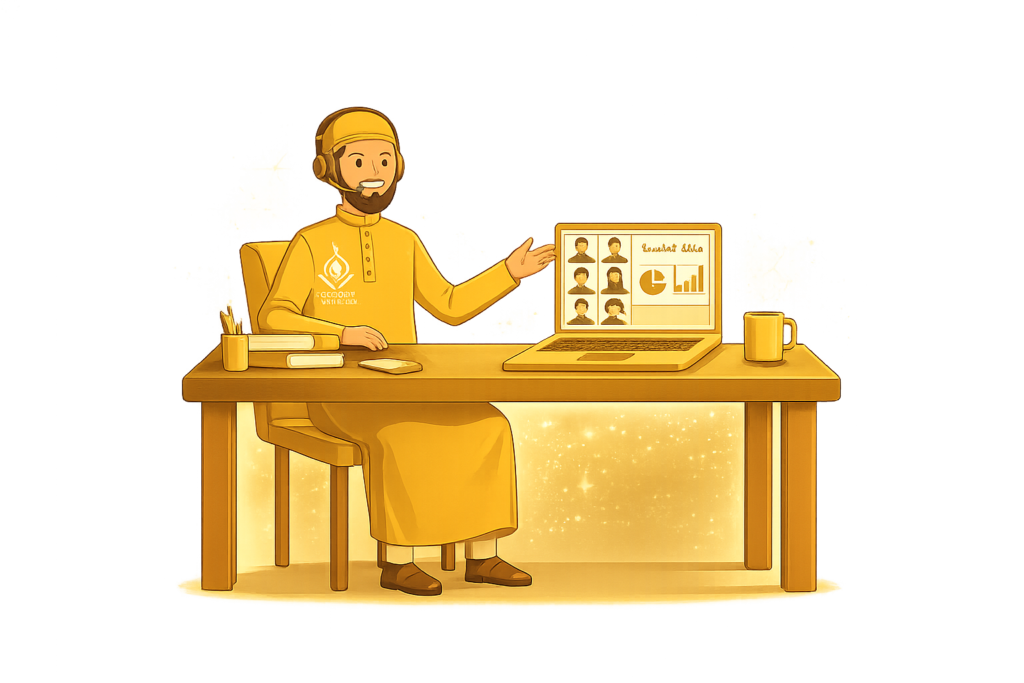
Online physics classes at Online Quran 24 run live over video call, one tutor to one student, using a shared digital whiteboard. Lessons are scheduled around the student’s own time zone, since the academy teaches students worldwide.

A typical class follows three simple steps:

  • A quick recap of the previous topic
  • New material, explained with worked examples
  • Two or three practice problems to close the session

Because sessions are one-on-one, the pace adjusts to the student. Our online physics tutors also keep a simple written record of what’s covered each week, so parents can track progress without sitting in on every class.

Why Choose Online Physics Tutors at Online Quran 24?

Choosing online physics tutors is really a decision about trust: who is teaching your child, and how much individual attention will they get. A few reasons families choose Online Quran 24:

  • One-on-one only – no group classes, so the tutor adapts to how the student learns
  • English or Urdu – lessons in whichever language the student is more comfortable in
  • Track record – more than 350 students taught over 5 years
  • Low-risk start – a 3-day free trial before any enrollment

What Makes the Best Physics Course Online?

Not every physics course is built the same way, and “best” depends on what a student actually needs. A few things worth checking before choosing one:

  • Is it one-on-one or group-based? One-on-one lets a tutor slow down or speed up based on a single student’s understanding.
  • Does the tutor explain concepts, or just run through formulas? Physics is easier to retain when a student understands why a formula works.
  • Is there a trial lesson? A short trial is the easiest way to judge teaching style before paying for a full course.
  • Does it match the student’s exam board or syllabus? O-Level, IGCSE, and general school curricula don’t all cover topics in the same order, so it’s worth checking alignment.
  • Can lessons happen in a language the student is comfortable with? Learning physics in a second language adds an extra layer of difficulty.

Format matters as much as syllabus, whether comparing academies or comparing individual tutors.

Top Physics Courses Online at Online Quran 24

Online Quran 24 structures its physics courses by level, so a student joins at the right starting point.

Course levels

  • Foundation Physics – core concepts and measurement, for students building a base before board-level topics
  • School-Level Physics – aligned to typical middle and high school topics: mechanics, waves, electricity
  • Exam-Prep Physics – focused practice for students preparing for school or board exams

Pricing and trial

  • 3-day free trial – for every new physics student, at no cost
  • 1-on-1 live classes – scheduled around the student’s own time zone
  • Contact the academy through onlinequran24.com for current course pricing, since fees can vary by level and class frequency

Beyond Physics: Chemistry, Biology, Mathematics and General Science Tutoring

Physics rarely stands alone on a student’s timetable. Online Quran 24 also teaches:

These subjects overlap more than students expect. A physics topic like energy connects directly to chemistry (chemical energy) and biology (how the body uses energy), while mathematics — especially algebra and graphing — underpins almost every physics calculation. Families often book multiple subjects with the same academy so scheduling stays simple.

Final Thoughts

Physics can feel intimidating on paper. With the right tutor and a format that fits a student’s pace and language, it becomes a subject students can genuinely enjoy rather than just get through.

What this comes down to for families:

  • Live, one-on-one classes — not pre-recorded videos
  • Instruction in English or Urdu
  • A 3-day free trial before any commitment

For families already familiar with the academy through Quran studies, the physics program extends the same trust-first approach to an academic subject.

FAQs About Physics

What Exactly Is Physics?

Physics is the branch of science that studies matter, energy, motion, and the forces that connect them — from why an apple falls to how a rocket reaches orbit. It’s one of the oldest natural sciences and forms the foundation for chemistry, engineering, and much of modern technology.

How Do Online Physics Classes Work?

Online physics classes at Online Quran 24 run live over video call, one tutor to one student, using a shared digital whiteboard. Lessons are scheduled around the student’s time zone since the academy teaches students worldwide, and each session builds on the last with short homework to reinforce the concept covered.

What Makes the Best Physics Course Online?

The best physics course fits how a student actually learns: one-on-one attention, a tutor who explains concepts rather than just formulas, a trial lesson to test fit, and the option to learn in a language — English or Urdu — the student is comfortable with.

Learn Quran Online with Expert Tutors

Online Academic Learning Hub

Physics support for more information