
Tauz: The Essential Guide to Seeking Allah's Refuge
Every journey toward spiritual clarity begins with a single act of boundary-setting. In the Islamic tradition, this boundary is established through Tauz. Before we open the Book of Allah or engage in acts of worship, we are taught to clear the mental and spiritual space. This isn’t just a ritualistic phrase; it is a psychological and theological shield.
At Online Quran 24, we often see students dive straight into recitation without realizing the weight of the words they utter first. This guide breaks down the nuances of seeking refuge, why it matters, and how it transforms your connection with the Divine.
What is Tauz in Islam?
The word Tauz (often spelled Ta’awwuz) comes from the Arabic root ‘A-W-DH, which signifies the act of seeking protection or fleeing to a place of safety. In an Islamic context, it refers specifically to the phrase:
أَعُوذُ بِٱللَّهِ مِنَ ٱلشَّيۡطَـٰنِ ٱلرَّجِيمِ
(A’udhu billahi min ash-shaytanir rajim)
Technically known as Isti’adha, this invocation serves as an acknowledgment of human vulnerability. We admit that external and internal whispers (waswasa) can distract us from our purpose. By reciting this, we transition from the noise of the material world into the sanctity of worship.

The Quranic Command to Recite Tauz
The requirement to seek refuge is not a mere suggestion; it is a divine instruction. Allah states in the Quran:
“So when you recite the Quran, [first] seek refuge in Allah from Satan, the expelled [from His mercy].” (Surah An-Nahl, 16:98).
In my years of teaching, I have observed that many believe this command applies only to the start of a formal prayer. However, the scholars of Tafsir (exegesis) point out that this applies to any time you intend to engage with the Word of Allah. It acts as a spiritual “filter,” ensuring your heart is receptive to guidance rather than clouded by prejudice or distraction.
Word-by-Word Meaning of Tauz (Ta’awwuz)
To truly feel the power of this phrase, we must peel back the layers of its vocabulary. Each word carries a specific weight that defines our relationship with the Creator.
| Arabic Word | Transliteration | English Meaning | Deep Context |
| أَعُوذُ | A’udhu | I seek refuge / I take shelter | An active, ongoing verb showing personal intent. |
| بِٱللَّهِ | Bi-Llah | In Allah | Identifying the only true source of ultimate safety. |
| مِنَ | Min | From | Establishing a distance between the self and the harm. |
| ٱلشَّيۡطَـٰنِ | Ash-Shaytan | The Satan / The Adversary | Any entity that is rebellious or leads one away from truth. |
| ٱلرَّجِيمِ | Ar-Rajim | The Outcast / The Accursed | Literally “the one who is pelted with stones” or rejected. |
Tauz with English Translation and Transliteration
For those new to the Arabic language, here is the complete breakdown:
Arabic: أَعُوذُ بِٱللَّهِ مِنَ ٱلشَّيۡطَـٰنِ ٱلرَّجِيمِ
Transliteration: A’udhu billahi min ash-shaytanir rajim.
English Translation: I seek refuge in Allah from Satan, the rejected.
Tauz in Hindi Translation
For our Hindi-speaking community at Online Quran 24, the meaning is as follows:
Hindi Script: मैं अल्लाह की पनाह माँगता हूँ शैतान मरदूद (धिक्कारे हुए) से।
Hindi Transliteration: Main Allah ki panaah maangta hoon Shaitaan mardood se.
The "Why" Behind the Protection: Nuanced Insights
Why do we seek refuge from an “outcast”? The term Ar-Rajim is significant. In ancient times, pelting with stones was a sign of total social rejection. By calling Shaytan Ar-Rajim, we remind ourselves that the whispers of doubt and arrogance are beneath us. They belong to a rejected state of being.
I have found that students who understand this linguistic root feel more empowered. They realize they aren’t just fighting a “ghost”; they are rejecting a mindset of rebellion and despair.
Benefits of “أَعُوذُ بِٱللَّهِ مِنَ ٱلشَّيۡطَـٰنِ ٱلرَّجِيمِ”
The impact of this phrase extends far beyond the prayer mat. It is a tool for emotional and mental regulation.
1. Mental Clarity During Study
When you start a quran translation course, the complexity of linguistics can sometimes feel overwhelming. Shaytan often uses frustration to make students quit. Reciting the refuge phrase refocuses the mind on the source of knowledge (Allah) rather than the difficulty of the task.
2. Emotional Regulation
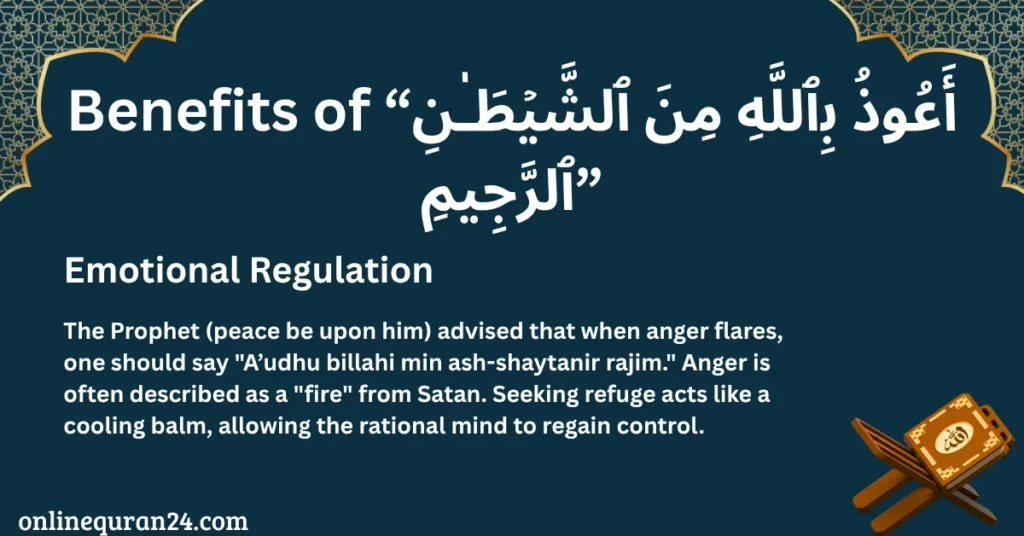
The Prophet (peace be upon him) advised that when anger flares, one should say “A’udhu billahi min ash-shaytanir rajim.” Anger is often described as a “fire” from Satan. Seeking refuge acts like a cooling balm, allowing the rational mind to regain control.
3. Sincerity in Worship (Ikhlas)
Distractions (Khawatir) are common during Salah. By starting with this phrase, you acknowledge that you cannot achieve focus on your own—you need Divine assistance to keep your heart present.
4. Protection from Arrogance
By admitting we need “refuge,” we humble ourselves. We acknowledge that we are not self-sufficient. This humility is the foundation of all spiritual growth.
Comparing Tauz and Tasmiyah (Bismillah Meaning)
It is common to confuse these two or view them as a single unit. However, they serve distinct purposes.
Tauz is about cleansing. It removes the negative influences and barriers between you and Allah.
Tasmiyah (Bismillah) is about blessing. It invites Divine grace into the action you are about to perform.
Bismillah meaning: “In the name of Allah, the Most Gracious, the Most Merciful.”
Think of it like this: If you want to paint a masterpiece, you must first clear the old dust off the canvas (Tauz) before you apply the vibrant colors (Bismillah). At Online Quran 24, we teach students to never skip the “clearing” phase, as a cluttered mind cannot hold the beauty of the Quranic message.
The Role of Tajweed in Reciting Tauz
Pronunciation is not just about accents; it is about preserving the integrity of the Divine message. In our tajweed course online, we emphasize three specific areas for this phrase:
The ‘Ayn (ع) in A’udhu: It must come from the middle of the throat. If it sounds like a flat “A,” the depth of the word is lost.
The ‘Thal’ (ذ): It is a soft sound made by placing the tip of the tongue against the edges of the upper teeth. Replacing it with a “Z” sound is a common error.
The Shaddah on the Sheen (ش) and Ra (ر): These double consonants provide the rhythmic “weight” that makes the recitation impactful.
Correcting these small details changes the experience from a habit to a conscious prayer.
Practical Applications: When Should You Recite It?
While the Quranic recitation is the primary time, there are several other moments where seeking refuge is essential:
Entering a state of anger: To prevent saying something regrettable.
Before sleep: To guard against disturbing dreams and restless thoughts.
When entering a bathroom: As taught in the Sunnah, to recognize the transition to a place of physical and ritual impurity.
Experiencing doubt: When “waswasa” (whispers) regarding faith or intentions arise.
Why Learn with Online Quran 24?
Understanding the “why” behind Islamic rituals is what we do best. Our quran translation course doesn’t just give you word-for-word meanings; it explores the historical and theological context of every Ayah.
We believe that education should be accessible and accurate. Whether you are looking for a tajweed course online to perfect your pronunciation of Tauz or a deeper dive into the meanings of the Quran, our instructors provide the human touch that AI or books alone cannot offer.
Conclusion
The act of seeking refuge is a declaration of independence. You are declaring your independence from the distractions of the world and your dependence on the Creator. By incorporating Tauz into your life with a clear understanding of its meaning, you build a fortress for your soul.
If you are ready to take the next step in your spiritual education, consider joining our community at Online Quran 24. From foundational Tajweed to advanced translation, we help you connect with the Quran on a level that is both intellectual and heart-centered.
FAQs About Tauz
In common usage, they are the same. Isti’adha is the formal Arabic term for the act of seeking refuge, while Ta’awwuz (Tauz) is the term more frequently used in South Asian and Persian-influenced Muslim cultures to refer to the specific phrase A’udhu billahi min ash-shaytanir rajim.
If you are reciting the Quran publicly or in a class setting, it is usually recited aloud at the very beginning. If you are starting your private prayer (Salah), the majority of schools of thought (Madhahib) suggest reciting it silently before the opening Surah.
Yes, according to the majority of scholars, it is a highly recommended Sunnah based on the command in Surah An-Nahl (16:98). Some scholars consider it obligatory (Wajib) at the start of a recitation session to ensure the sanctity of the act.