Online Chemistry Course – Definition, Types, History & Live Classes
Online Quran 24 offers live online chemistry classes for kids, teens, adults, and homeschooling families worldwide, alongside our academic and Quranic programs. If you’re wondering what chemistry is, which chemistry topics matter most, or how our classes actually work, this page walks you through it — and you can try a class free for 3 days before deciding to enroll.
Who Teaches Our Chemistry Classes
Trust matters, especially when you’re choosing an online tutor for your child or for yourself. Here’s what you should know about how our chemistry classes are run:
Tutors are selected for both subject knowledge and the ability to explain chemistry clearly to different age groups — from a first-time learner asking “what is chemistry?” to a student preparing for exams.
Classes are live and interactive, not pre-recorded videos, so students can ask questions as they come up rather than waiting until the end.
Lessons are available in English or Urdu medium, depending on what suits the student and family best.
Online Quran 24 has been teaching online for 5 years and has worked with 350+ students across our Quran, science, and academic programs, chemistry included.
What Is Chemistry? A Simple Definition
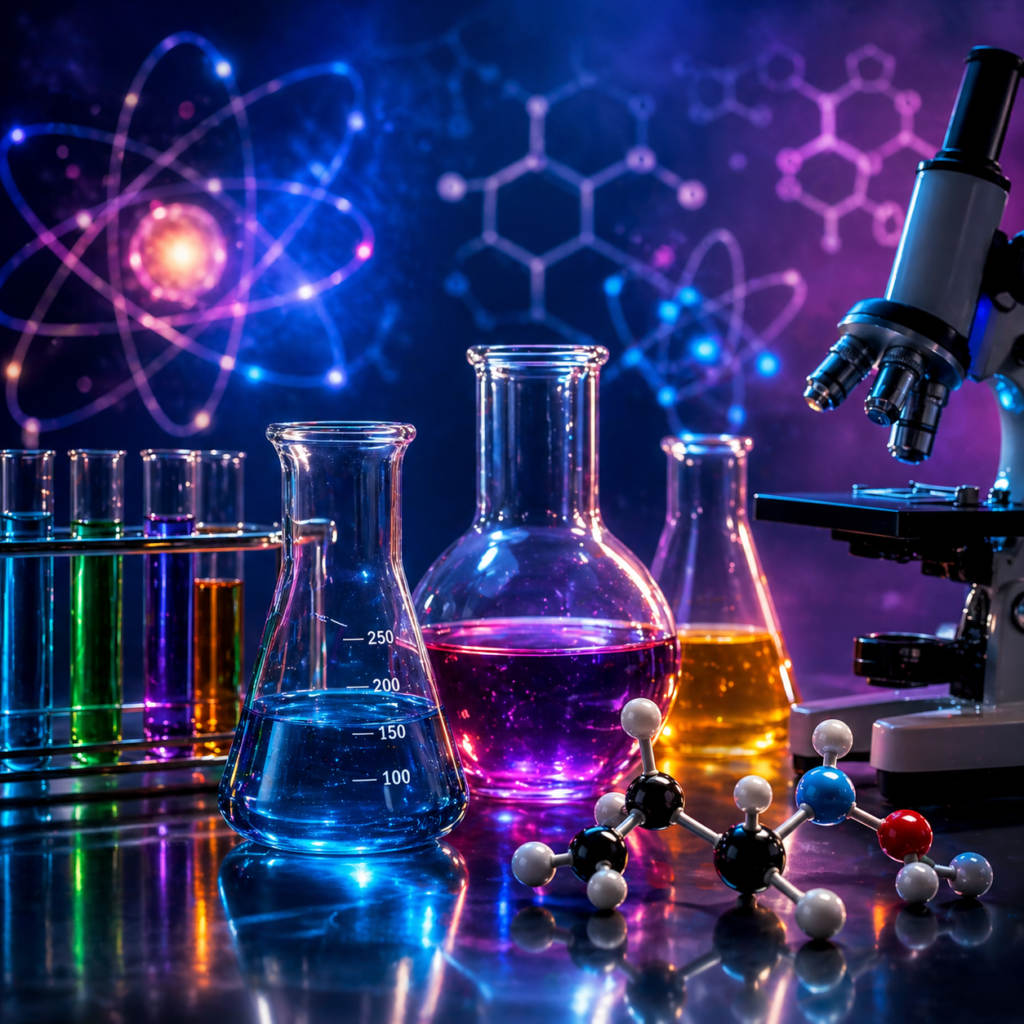
What is a simple definition of chemistry? Chemistry is the branch of science that studies what matter is made of, how it’s structured, and how it changes when different substances interact. In everyday terms, chemistry explains things like why ice melts, why bread rises, or why metal rusts.
Because chemistry sits at the center of the physical world, it connects closely with biology, physics, and general science. In our chemistry course, students build this understanding gradually — starting with the basic definition of chemistry before moving on to specific chemistry topics and more advanced ideas as they progress.
Chemistry Topics We Cover
Our chemistry course is structured around the topics students actually need, whether they’re meeting the subject for the first time or reinforcing school-level chemistry. Lessons move from the basics toward more applied ideas at a pace that fits the student.
Foundational Topics
Atoms, elements, and the periodic table
Chemical bonding — how atoms join together
Compounds and mixtures
States of matter: solids, liquids, and gases
Applied & Everyday Chemistry
Chemical reactions and simple equations
Acids, bases, and pH
Everyday chemistry — why cooking, cleaning, and even breathing involve chemical reactions
What are 5 chemistry types? Chemistry is commonly divided into five main branches: organic chemistry, inorganic chemistry, physical chemistry, analytical chemistry, and biochemistry. Each branch looks at a different slice of how matter and energy behave.
Organic chemistry – studies carbon-based compounds, which make up most living things and many everyday products.
Inorganic chemistry – covers minerals, metals, and compounds without carbon-hydrogen bonds.
Physical chemistry – examines how energy affects chemical reactions and physical properties.
Analytical chemistry – focuses on identifying and measuring exactly what a substance contains.
Biochemistry – studies the chemical processes inside living organisms, linking chemistry directly to biology.
Students don’t need to master all five branches at once. Most classes start with general chemistry basics and move into a specific branch only once the fundamentals are solid.
A Brief History of Chemistry
Chemistry’s roots trace back to ancient alchemy, when early experimenters worked with metals, minerals, and mixtures long before the modern scientific method existed. The field became far more structured in the 1700s, particularly once chemists established that matter is conserved during chemical reactions rather than created or destroyed. In 1869, the periodic table brought order to how elements are classified — a foundation that modern chemistry, and this course, still builds on today.
Interesting Chemistry Facts
A few facts that often help chemistry topics click for students:
Water is one of the very few substances that becomes less dense when it freezes, which is why ice floats instead of sinking.
The human body relies on constant chemical reactions just to breathe, digest food, and think.
Gold barely reacts with other elements, which is part of why it doesn’t tarnish or rust over time.
A rusting nail and a burning candle are both chemical reactions — just at very different speeds.
How Do Online Chemistry Classes Work?
How do online chemistry classes work? Classes are held live over video call, scheduled around the student’s own time zone. Sessions typically run one-on-one or in small groups, use a shared digital whiteboard for diagrams and equations, and are paced to the student’s current level — starting with definitions and building toward specific chemistry topics from there.
Because Online Quran 24 teaches families across many countries, scheduling is flexible rather than tied to one region’s school calendar.
Who Is This Chemistry Course For?
Kids and teens who want extra support with school-level chemistry
Homeschooling parents building a full academic curriculum
Adult beginners with no prior science background
Families who prefer English- or Urdu-medium instruction
Reverts and new Muslim families setting up both academic and Islamic learning for their children
Course Format & Free Trial
Class Options
One-on-one or small-group live sessions
English or Urdu medium, by preference
Flexible scheduling for students worldwide
Free 3-Day Trial
Before committing to a paid plan, you can book a 3-day free trial to meet a tutor, see how a lesson is structured, and check that the pace and teaching style fit your child — or yourself.
Learn Chemistry Alongside Other Subjects
Many families join Online Quran 24 for one subject and end up building a full learning plan around it. Alongside chemistry, we also teach biology, general science, mathematics, and English, as well as our core Quran and Tajweed programs — in English or Urdu medium. This makes it possible to cover a child’s academic subjects and Islamic education through a single, consistent platform, with one set of tutors and one schedule to manage.
Final Thoughts
Chemistry can feel abstract from a textbook alone, especially for a student meeting the subject for the first time. Live, one-on-one teaching — with room to actually ask “why” until it makes sense — tends to make the definitions, topics, and types of chemistry click faster than self-study ever does. If that sounds like what you or your child needs, the next step is simple: book your free 3-day trial and sit in on a real class before deciding anything further.
FAQs About Chemistry
What is chemistry?
Chemistry is the branch of science that studies what matter is made of, how it’s structured, and how it changes when different substances interact — for example, why ice melts or why metal rusts.
What are the 5 main types of chemistry?
Chemistry is commonly divided into five branches: organic chemistry, inorganic chemistry, physical chemistry, analytical chemistry, and biochemistry, each focused on a different aspect of how matter and energy behave.
What chemistry topics does the course cover?
The course covers atoms and elements, the periodic table, chemical bonding, compounds and mixtures, states of matter, chemical reactions, acids and bases, and everyday applications of chemistry.