
Fa Inna Ma'al Usri Yusra: Meaning, Context, and Lessons from Surah Ash-Sharh
Few phrases in the Quran carry as much quiet comfort as fa inna ma’al usri yusra — “for indeed, with hardship comes ease.” Parents recite it to children going through a tough school term. Adults repeat it to themselves during illness, financial strain, or grief. It shows up in reminders, wall art, and late-night messages between friends going through hard times.
But the phrase means more than a comforting saying. It comes from a specific chapter of the Quran, revealed at a specific moment, and it carries a grammatical nuance that classical scholars have written about for centuries. This article walks through what the verse actually says, where it comes from, what it means in Arabic, English, Urdu, and Hindi, and how it can be understood and taught — especially to children learning the Quran for the first time.
What Does "Fa Inna Ma'al Usri Yusra" Mean?
At its simplest, fa inna ma’al usri yusra meaning is: “For indeed, with hardship comes ease.” It’s a promise, not a suggestion — the Arabic sentence structure states this as a certainty, not a possibility.
Fa inna ma'al usri yusra in Arabic
The verse appears in Arabic as:
فَإِنَّ مَعَ الْعُسْرِ يُسْرًا
Written out fully, fa inna ma al usri yusra in arabic is this exact phrase, transliterated as Fa-inna ma’a al-‘usri yusra.
- Fa — “for” / “so”
- Inna — “indeed” / “truly” (used for emphasis)
- Ma’a — “with” / “along with”
- Al-‘usr — “the hardship” (with the definite article “the”)
- Yusra — “ease” (without a definite article)
Verse 6 repeats the same promise without the opening “fa”: إِنَّ مَعَ الْعُسْرِ يُسْرًا (Inna ma’a al-‘usri yusra). Seeing inna ma al usri yusra in arabic written this way — one word shorter than verse 5 — is the first clue that the Quran is deliberately restating the same idea for emphasis, not introducing a new one.
That small grammatical detail — definite “hardship” versus indefinite “ease” — matters more than it looks, and we’ll come back to it shortly.
Fa Inna Ma'al Usri Yusra Meaning in English
Different English translations phrase it slightly differently, though the meaning stays consistent:
- Sahih International: “For indeed, with hardship [will be] ease.”
- Dr. Mustafa Khattab (The Clear Quran): “Surely with that hardship comes more ease.”
- Abdul Haleem: “Truly where there is hardship there is also ease.”
So the fa inna ma’al usri yusra meaning in english is a direct assurance: no matter how difficult a situation feels, ease is already attached to it — not promised for someday, but present with it. The inna ma’al usri yusra meaning in english for verse 6 is identical in substance — “Indeed, with hardship comes ease” — since dropping “fa” only removes the connecting word “for,” not the promise itself.
Fa Inna Ma'al Usri Yusra Meaning in Urdu
The fa inna ma’al usri yusra meaning in urdu (also written fa inna ma al usri yusra meaning in urdu) — verse 5 of Surah Ash-Sharh — is:
“بے شک ہر مشکل کے ساتھ آسانی ہے۔”
(“Undoubtedly, with every difficulty there is ease.”)
Fa Inna Ma'al Usri Yusra Meaning in Hindi
The fa inna ma’al usri yusra meaning in hindi — verse 5 of Surah Ash-Sharh — is:
“निश्चय ही, हर कठिनाई के साथ आसानी है।”
(“Certainly, with every difficulty there is ease.”)
Surah Ash-Sharh: The Context of "Fa Inna Ma'al Usri Yusra"
This verse isn’t a standalone saying — it’s verse 5 of Surah Ash-Sharh (also known as Al-Inshirah), the 94th chapter of the Quran. The surah has only eight verses and was revealed in Makkah, during a period when the Prophet Muhammad ﷺ and the early Muslim community faced intense hardship, rejection, and pressure from the Quraysh.
Here is the full surah, with transliteration and meaning, for context:
| # | Arabic | Transliteration | Meaning |
|---|---|---|---|
| 1 | أَلَمْ نَشْرَحْ لَكَ صَدْرَكَ | Alam nashrah laka sadrak | Have We not expanded for you your breast? |
| 2 | وَوَضَعْنَا عَنكَ وِزْرَكَ | Wa wada’na ‘anka wizrak | And We removed from you your burden |
| 3 | الَّذِي أَنقَضَ ظَهْرَكَ | Alladhi anqada zahrak | Which had weighed upon your back |
| 4 | وَرَفَعْنَا لَكَ ذِكْرَكَ | Wa rafa’na laka dhikrak | And raised high for you your repute |
| 5 | فَإِنَّ مَعَ الْعُسْرِ يُسْرًا | Fa-inna ma’a al-‘usri yusra | For indeed, with hardship [will be] ease |
| 6 | إِنَّ مَعَ الْعُسْرِ يُسْرًا | Inna ma’a al-‘usri yusra | Indeed, with hardship [will be] ease |
| 7 | فَإِذَا فَرَغْتَ فَانصَبْ | Fa-idha faraghta fansab | So when you have finished, then stand up [for worship] |
| 8 | وَإِلَىٰ رَبِّكَ فَارْغَب | Wa ila rabbika farghab | And to your Lord direct your longing |
What Does "أَلَمْ نَشْرَحْ لَكَ صَدْرَكَ" (Alam Nashrah Laka Sadrak) Mean?
The surah opens with أَلَمْ نَشْرَحْ لَكَ صَدْرَكَ — “Have We not expanded for you your breast?” This is understood by commentators as Allah reminding the Prophet ﷺ that his heart had been given peace, capacity, and strength to carry his mission, despite the weight of opposition around him.
Read together, the surah moves from reassurance (your heart has been eased, your burden lifted) into promise (ease accompanies hardship) into instruction (so when relieved of one task, turn to worship). The verse about ease doesn’t stand alone — it sits inside a message of comfort meant for someone going through a genuinely difficult chapter of life.
Inna Ma'al Usri Yusra — Why Is the Verse Repeated Twice?
One detail readers often notice is that verses 5 and 6 say almost the same thing — which is also why many people search separately for the inna ma al usri yusra meaning, treating it as slightly distinct from verse 5:
- Verse 5: Fa-inna ma’al ‘usri yusra
- Verse 6: Inna ma’al ‘usri yusra
Classical commentators, including Ibn Kathir and Al-Qurtubi, point to a specific feature of Arabic grammar here. When a definite noun (one with “al,” meaning “the”) is repeated, it refers back to the same thing. When an indefinite noun is repeated, it refers to something new each time.
In these two verses, al-‘usr (“the hardship”) is definite both times — so it’s the same hardship being spoken about, not a new one. But yusra (“ease”) is indefinite both times, which means the second “ease” is not simply a repeat of the first — it’s a distinct instance of ease.
The conclusion many scholars draw from this: one hardship is met not by one ease, but by more than one. This idea is reflected in a well-known tradition attributed to Hasan al-Basri, describing the Prophet ﷺ sharing this as good news with his companions — that a single hardship cannot overcome two forms of ease. Whatever the exact wording of that report, the grammatical structure of the verses themselves supports the same reading: difficulty is temporary and outweighed by what follows it.
Inna Ma'al Usri Yusra Meaning in Urdu
The inna ma’al usri yusra meaning in urdu — verse 6, the shorter repeated form without “fa” — carries the exact same meaning:
“بے شک ہر مشکل کے ساتھ آسانی ہے۔”
(“Undoubtedly, with every difficulty there is ease.”)
Different Urdu Quran translations phrase this with slightly different word choices — some use “دشواری” instead of “مشکل,” and some translators keep “بے شک” at the very start to match the emphasis of the Arabic “inna.” The meaning stays the same across all of them.
Inna Ma'al Usri Yusra Meaning in Hindi
The inna ma al usri yusra meaning in hindi — verse 6, the shorter repeated form without “fa” — carries the exact same meaning:
“निश्चय ही, हर कठिनाई के साथ आसानी है।”
(“Certainly, with every difficulty there is ease.”)
Inna Ma'al Usri Yusra Meaning in English
The inna ma’al usri yusra meaning in english — verse 6, the shorter repeated form without “fa” — is:
“Indeed, with hardship comes ease.”
This is identical in substance to verse 5’s promise, since dropping “fa” only removes the connecting word “for,” not the meaning itself.
Inna Ma'al Usri Yusra Meaning in arabic
The inna ma al usri yusra in arabic — verse 6, the shorter repeated form without “fa” — is written as:
إِنَّ مَعَ الْعُسْرِ يُسْرًا
Transliterated: Inna ma’a al-‘usri yusra.
The Benefits of Reflecting on Fa Inna Ma'al Usri Yusra
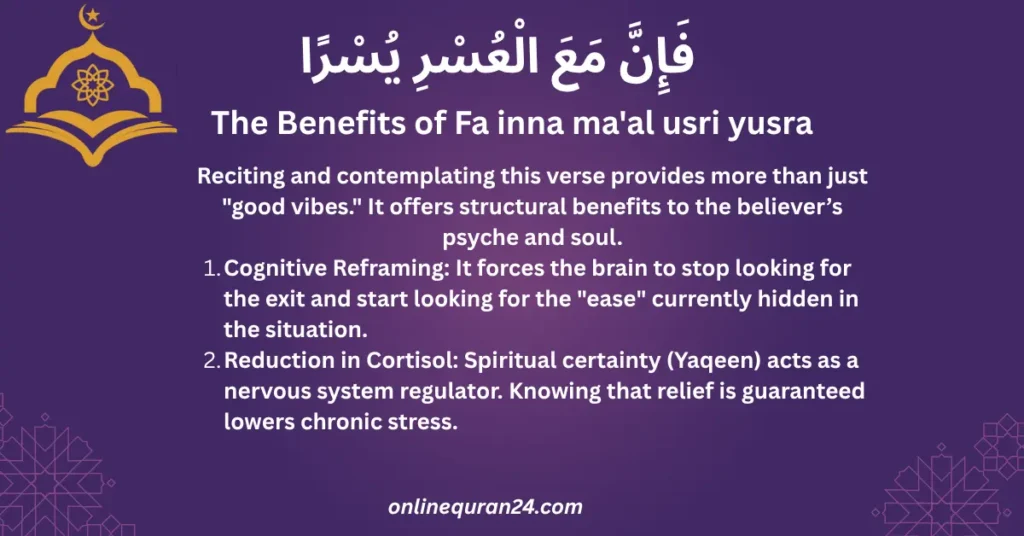
Understanding the benefits of fa inna ma al usri yusra — also written benefits of fa inna ma’al usri yusra — goes beyond memorizing a translation. Reflecting on this verse regularly can shape how a person responds to difficulty:
- Builds patience (sabr) — a reminder that hardship has a natural limit, which makes it easier to endure without panic.
- Strengthens trust in Allah (tawakkul) — the verse frames ease as something already attached to the hardship, not something uncertain.
- Offers perspective during trials — hard seasons feel less permanent when framed against a promise like this one.
- Provides language for comfort — many Muslims use this verse specifically to console others, since it doesn’t dismiss the hardship but sits alongside it.
- Encourages continued effort — the surah’s closing verses (7–8) pair the promise of ease with a call to keep working and turn to worship, not to simply wait passively.
Supporting Your Journey: Bismillah and Quranic Duas
To fully activate the power of this verse, it should be integrated into a broader spiritual practice. This begins with understanding the bismillah meaning. When you say Bismillah hir-Rahman nir-Rahim, you are invoking the Boundless Mercy of God. This mercy is the source of the “Ease” mentioned in the verse.
Essential Quranic Duas for Difficult Times
In addition to reciting Surah Ash-Sharh, I recommend these quranic duas for those in the midst of Al-Usr:
The Dua of Yunus (AS): “La ilaha illa anta subhanaka inni kuntu minaz-zalimin.” (There is no deity except You; exalted are You. Indeed, I have been of the wrongdoers.)
The Dua for Ease: “Allahumma la sahla illa ma ja’altahu sahla, wa anta taj’alul-hazna idha shi’ta sahla.” (O Allah, there is no ease except in what You have made easy, and You make the difficulty easy if You wish.)
Powerful Quranic Duas for Hardship
While Fa inna ma’al usri yusra is a statement of fact, we often need active prayers to navigate the storm. I recommend pairing this verse with:
Hasbunallahu wa ni’mal wakeel (Sufficient for us is Allah, and He is the best Disposer of affairs).
Rabbi inni lima anzalta ilayya min khayrin faqeer (My Lord, indeed I am, for whatever good You would send down to me, in need).
How to Apply This Verse During Difficult Times
Knowing the meaning is one step; using it is another. A few practical ways people apply this verse:
- Recite it during hardship, not just read about it — many find repeating the Arabic verse itself, slowly, more grounding than only recalling the translation.
- Pair it with dua — asking Allah directly for the ease the verse describes, rather than only reflecting on the promise in the abstract.
- Keep up daily prayers (salah) during hard periods, in line with verse 7’s instruction to turn to worship once immediate duties are handled.
- Take practical action alongside patience — the surah doesn’t suggest waiting without effort; verse 7 specifically calls for continued effort.
- Share it with someone struggling — quoting this verse to a friend or family member going through a hard time is a common and meaningful form of support in Muslim communities.
Teaching Children the Meaning of Fa Inna Ma'al Usri Yusra
Surah Ash-Sharh is short, memorable, and one of the earlier surahs many children learn by heart. But memorizing the sounds without understanding the meaning leaves out most of its value. A child who can recite “inna ma’al usri yusra” but doesn’t know it means “with hardship comes ease” is missing the actual comfort the verse offers.
This is where structured tafsir and translation matter — not just tajweed and pronunciation. At Online Quran 24, one-to-one online classes go beyond correct recitation to include the meaning of short surahs like Ash-Sharh, so children connect the words they’re memorizing to something they can actually use — during a hard exam, a tough friendship moment, or any ordinary childhood struggle.
For a child, learning that this verse was revealed to comfort the Prophet ﷺ himself during a genuinely hard period can make the Quran feel less like a memorization task and more like something meant for their own life too.
Final Thought
Surah Ash-Sharh was revealed for a moment of real hardship, and its message hasn’t lost relevance since. “Fa inna ma’al usri yusra” isn’t a phrase to memorize and move past — it’s a promise worth sitting with, in Arabic and in whatever language makes it clearest, especially when life feels heavy.
If you’re raising children who are learning to recite this surah, consider making sure they also understand what it means. A verse like this one is far more valuable once a child knows why it was revealed and what it’s promising them.
FAQs About Fa inna ma'al usri yusra meaning
It means “for indeed, with hardship comes ease.” It’s verse 5 of Surah Ash-Sharh, and it states that ease accompanies difficulty rather than arriving only after it.
It carries the same meaning as verse 5, without the opening “fa” (for/so): “Indeed, with hardship comes ease.” It’s verse 6, repeating the promise for emphasis.
For many readers, it’s a personal anchor — a short phrase to return to during stress, grief, or uncertainty, offering reassurance that the current difficulty has a limit.
Technically, it is a statement of fact (Khabar) from the Quran. However, it is frequently used as a dhikr (remembrance) or a form of prayer to calm the heart during stressful times.
The verse doesn’t only say ease comes “after” hardship — it says ease comes “with” it. Classical commentary on the repeated verses (5 and 6) suggests more than one form of ease accompanies a single hardship.
This is found in Surah Ash-Sharh (also called Al-Inshirah), chapter 94, verses 5 and 6 of the Quran.
It means “निश्चय ही, हर कठिनाई के साथ आसानी है” — “certainly, with every difficulty there is ease.” This is verse 6 of Surah Ash-Sharh, chapter 94 of the Quran.