The Complete Guide to Online Quran Classes for Kids 2026
The Complete Parent’s Guide to Online Quran Classes for Kids For Muslim parents living in Western countries, passing down the beautiful tradition of reciting and
Read More »

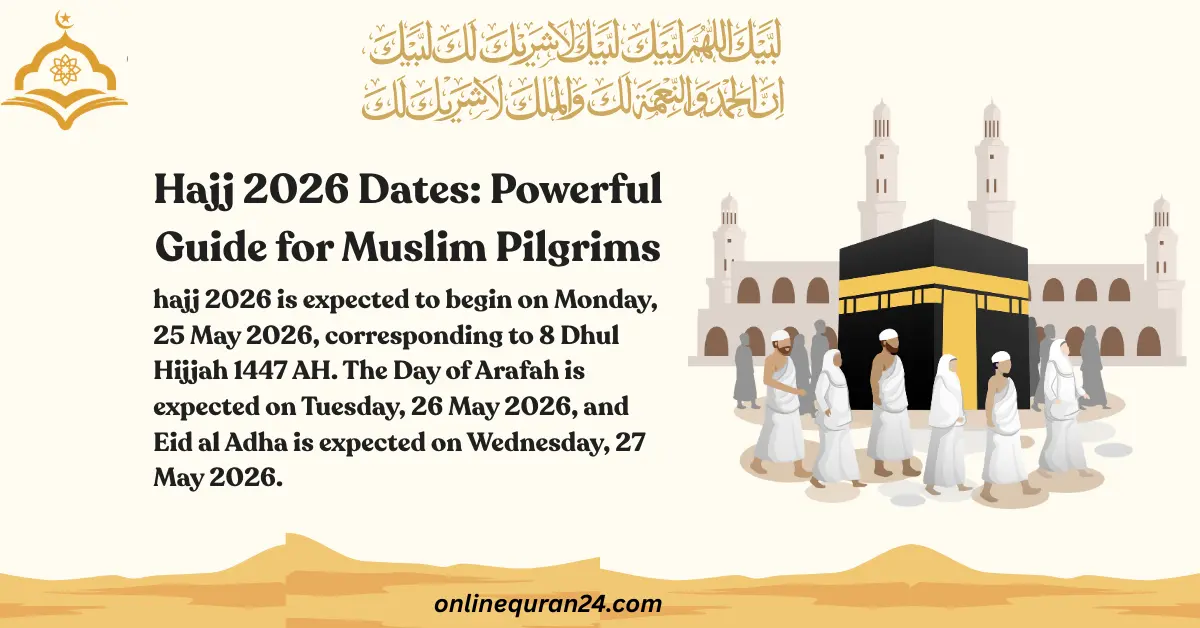
hajj 2026 is expected to begin on Monday, 25 May 2026, corresponding to 8 Dhul Hijjah 1447 AH. The Day of Arafah is expected on Tuesday, 26 May 2026, and Eid al Adha is expected on Wednesday, 27 May 2026. These dates are based on projected Hijri calendar calculations for Makkah, and the final announcement depends on the official moon sighting in Saudi Arabia. Islamic Relief’s 2026 calendar lists Dhul Hijjah begins on 18 May 2026, Hajj begins on 25 May 2026, The Day of Arafah on 26 May 2026, and Eid al Adha on 27 May 2026.
For readers of Online Quran 24, this guide explains when is Hajj 2026?, what is hajj, How Long Does Hajj Last?, where it happens, who must perform it, who may be excused, and how Muslims at home can still benefit from the first 10 days of dhul hijjah.
| Event | Expected Gregorian Date | Hijri Date |
|---|---|---|
| Dhul Hijjah 2026 begins | 18 May 2026 | 1 Dhul Hijjah 1447 |
| hajj 2026 begins | 25 May 2026 | 8 Dhul Hijjah 1447 |
| Day of Arafah | 26 May 2026 | 9 Dhul Hijjah 1447 |
| Eid al Adha | 27 May 2026 | 10 Dhul Hijjah 1447 |
| Days of Tashreeq | 28 to 30 May 2026 | 11 to 13 Dhul Hijjah 1447 |
A Hijri calendar listing for Dhul Hijjah 1447 also places 8 Dhul Hijjah on 25 May 2026, 9 Dhul Hijjah on 26 May 2026, 10 Dhul Hijjah on 27 May 2026, and 13 Dhul Hijjah on 30 May 2026.
Do not treat the date as final until Saudi Arabia confirms the moon sighting. The Hijri calendar follows the lunar cycle. That means hajj 2026 dates may shift by one day.
When I prepare a Hajj calendar for students or families, I always tell them to plan early but keep the final travel and worship reminders flexible. A one day shift can affect fasting on Arafah, Eid prayer planning, Qurbani timing, and family gatherings.
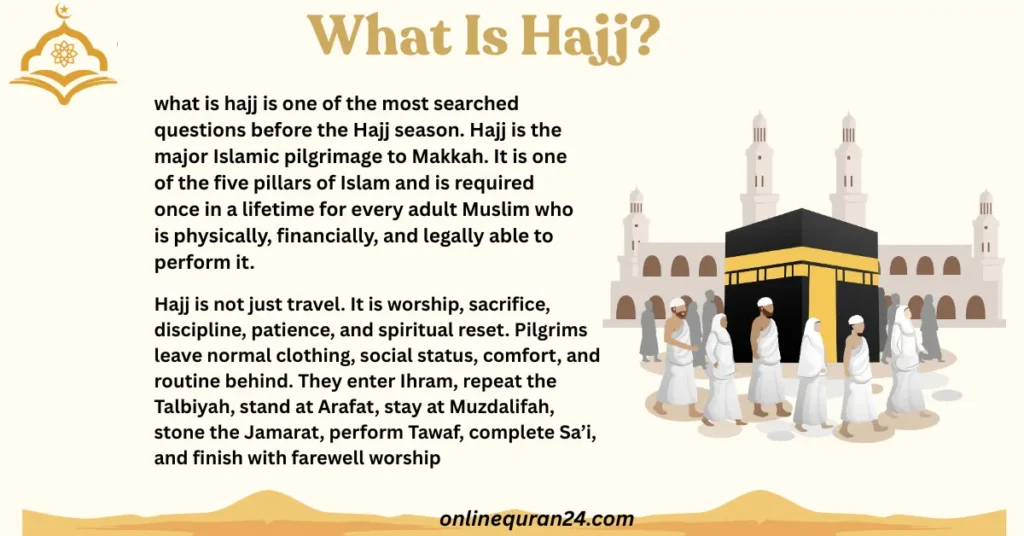
what is hajj is one of the most searched questions before the Hajj season. Hajj is the major Islamic pilgrimage to Makkah. It is one of the five pillars of Islam and is required once in a lifetime for every adult Muslim who is physically, financially, and legally able to perform it.
The Quran makes Hajj an obligation for those who are able to make the journey. Surah Al Imran 3:97 states that pilgrimage to the House is due to Allah from those who can find a way to it. The Saudi Ministry of Hajj and Umrah also highlights Hajj as a major act of worship with great spiritual reward and lists its core pillars and guidance for pilgrims.
Hajj is not just travel. It is worship, sacrifice, discipline, patience, and spiritual reset. Pilgrims leave normal clothing, social status, comfort, and routine behind. They enter Ihram, repeat the Talbiyah, stand at Arafat, stay at Muzdalifah, stone the Jamarat, perform Tawaf, complete Sa’i, and finish with farewell worship.
hajj 2026 will take place in late May. This is important because Saudi Arabia can be very hot during this period. Pilgrims should prepare physically, medically, and spiritually.
The Ministry of Hajj and Umrah warns that heatstroke is common during Hajj, especially during Tawaf, Sa’i, Arafah at noon, Mina, slaughter areas, and the Jamarat because of crowding, heat, and long walking distances. It advises pilgrims to drink fluids, avoid long sun exposure, use an umbrella and sunglasses, rest after rituals, and wear loose light clothing.
This is where practical planning matters. A pilgrim who studies the rituals but ignores sleep, hydration, shoes, medicine, and crowd movement may struggle. Hajj rewards patience, but it also requires preparation.
The Expected Dates for Hajj 2026 are 25 May to 30 May 2026.
This covers:
So, when people ask When is Hajj 2026?, the best answer is:
hajj 2026 is expected from 25 May to 30 May 2026, with the main Hajj day, Arafah, expected on 26 May 2026.
Below is a simple Hajj 2026 Day-by-Day Schedule for readers who want the full flow.
This day is known as Yawm al Tarwiyah. Pilgrims enter or renew Ihram and move to Mina. They spend the day and night in prayer, rest, reflection, and preparation.
The first lesson of this day is calmness. Many first time pilgrims feel emotional and rushed. I always advise
This is the Day of Arafah. It is the heart of Hajj. Pilgrims travel from Mina to the plain of Arafat and spend the day in dua, repentance, and remembrance of Allah.
Arafah is the pillar that cannot be missed. Travel guides often say that missing Arafah invalidates Hajj because the Prophet Muhammad, peace be upon him, said that Hajj is Arafah. Modern Hajj guides also describe Arafah as the most important day of the pilgrimage.
After sunset, pilgrims leave Arafat and move to Muzdalifah. They combine Maghrib and Isha prayers, rest under the open sky, and collect pebbles for the stoning ritual.
This night teaches simplicity. There is no luxury hotel feeling here. It is a reminder that every person returns to Allah with deeds, not status.
This is Eid al Adha. It is also one of the busiest days of Hajj.
Pilgrims usually perform these key actions:
This day needs patience. Crowds move in waves. Pilgrims should follow group instructions and avoid trying to rush every step at peak time.
These are part of the Days of Tashreeq. Pilgrims stay in Mina and stone all three Jamarat.
Some pilgrims leave Mina after completing the rites on 12 Dhul Hijjah. Others stay until 13 Dhul Hijjah.
Pilgrims who remain in Mina complete the final stoning. Before leaving Makkah, pilgrims perform Tawaf al Wada, the farewell Tawaf.
How Long Does Hajj Last? Hajj normally lasts five to six days, from 8 to 12 or 13 Dhul Hijjah.
The shorter form ends on 12 Dhul Hijjah for pilgrims who leave Mina on time. The longer form ends on 13 Dhul Hijjah for those who stay an extra day.
For hajj 2026, this means the main rites are expected from 25 May to 29 or 30 May 2026.
No, Hajj does not occur on the same Gregorian dates every year.
The Islamic calendar is lunar. It has 12 months and is about 354 or 355 days long. Because it is shorter than the solar calendar, Islamic dates move earlier by around 10 days each year, and the cycle repeats across seasons roughly every 33 years.
That is why Hajj may fall in summer in some years and winter in others. This also explains why Dhul Hijjah 2026 falls in May, while future Hajj seasons will continue moving earlier in the Gregorian calendar.
Where Does The Hajj Take Place? Hajj takes place in and around Makkah in Saudi Arabia.
The main sacred sites include:
The Saudi Ministry of Hajj and Umrah describes key Hajj areas, health guidance, and pilgrim assistance services around the Grand Mosque and the Holy Sites.
Each location has a spiritual role. Mina teaches patience and community. Arafat teaches repentance. Muzdalifah teaches humility. Tawaf teaches devotion. Sa’i teaches trust in Allah through the story of Hajar, peace be upon her.
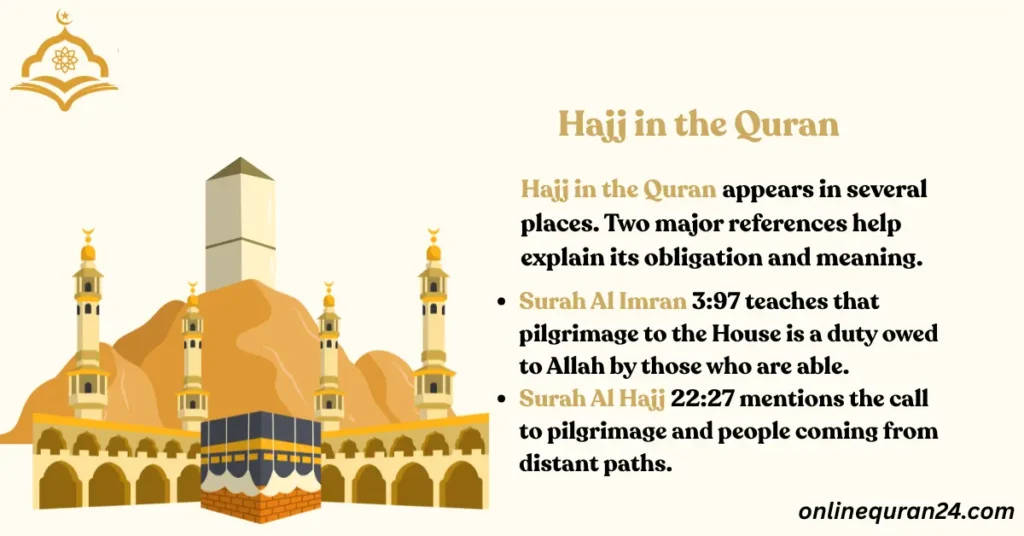
Hajj in the Quran appears in several places. Two major references help explain its obligation and meaning.
Surah Al Imran 3:97 teaches that pilgrimage to the House is a duty owed to Allah by those who are able.
Surah Al Hajj 22:27 mentions the call to pilgrimage and people coming from distant paths.
These verses show two important points:
That second point matters. Many Muslims feel guilty when they cannot go. But the Quran connects the obligation to ability. If someone lacks health, safety, legal permission, or financial means, they should not fall into despair.
The History Of The Hajj connects deeply to Prophet Ibrahim, peace be upon him, his family, and the building of the Kaaba. Muslims believe Hajj preserves acts of faith, sacrifice, trust, and submission.
The movement between Safa and Marwah reminds Muslims of Hajar’s search for water. The sacrifice of Eid al Adha connects to Ibrahim’s obedience to Allah. The stoning of the Jamarat reminds pilgrims to reject evil and temptation.
What makes Hajj powerful is that it turns history into lived worship. Pilgrims do not only read about faith. They walk through it.
The Main Rituals of Hajj include:
This is not just two pieces of cloth. It is a mental boundary. Once in Ihram, you cannot argue, hunt, or even cut your nails. It forces a level of self-control that is rare in modern life.
Pilgrims repeat the Talbiyah, declaring their response to Allah’s call.
Walking between the hills of Safa and Marwah seven times commemorates Hajar’s search for water for her son Ismail. It represents the “effort” (Sa’i) we must put into our faith
Pilgrims walk between Safa and Marwah seven times.
Pilgrims stay in Mina before and after Arafah.
Arafat is the central pillar of Hajj. Pilgrims stand in worship, dua, and repentance.
Pilgrims spend the night and prepare for the next day.
Pilgrims stone the Jamarat as a symbol of rejecting Shaytan.
Pilgrims arrange sacrifice, often through official Hajj systems or package providers.
This is a major Tawaf of Hajj.
This farewell Tawaf is performed before leaving Makkah.
Hajj is obligatory only on Muslims who have the ability. Ability includes faith, adulthood, soundness of mind, physical capacity, financial means, safe travel, and legal permission.
A person may be excused or not required to perform Hajj if:
Saudi travel rules also state that non Muslims are not allowed to travel to Makkah, and Hajj or Umrah visas are not for work or residency.
The Ministry of Hajj and Umrah advises pilgrims to see a doctor before travel, confirm health stability, take necessary immunizations, carry enough medication, and bring medical reports if they have chronic conditions.
What to do if you cannot perform Hajj? Start with hope, not guilt.
A Muslim who cannot attend hajj 2026 can still worship deeply during Dhul Hijjah 2026, especially in the first 10 days of dhul hijjah.
Here are practical actions:
Hadith sources mention that righteous deeds in the first ten days of Dhul Hijjah are especially beloved to Allah. Sahih Muslim also reports the virtue of fasting on the Day of Arafah for non pilgrims.
How Muslims at Home Can Earn Hajj 2026 Rewards is a beautiful topic because not everyone can travel.
You can create a home worship plan from 1 to 10 Dhul Hijjah:
Fasting: Specifically fasting on the Day of Arafah (9th Dhul Hijjah) expiates the sins of the previous year and the coming year.
Dhikr: Frequently reciting the Takbeerat (Allahu Akbar, Allahu Akbar…).
Charity: Increasing your Sadaqah during this window.
Qurbani: Offering a sacrifice to feed the poor.
Spiritual preparation matters, but practical preparation also matters.
Do not wait until the flight. Study Ihram, Tawaf, Sa’i, Arafah, Muzdalifah, Mina, Jamarat, and Tawaf al Wada.
Hajj involves long walks and standing in crowds. Start with daily walking and increase gradually.
Visit your doctor. Review medicines. Take vaccinations according to official requirements. Carry a medical report if you have diabetes, asthma, kidney disease, heart disease, allergies, or high blood pressure. The Saudi Ministry of Hajj and Umrah specifically recommends medical consultation, immunizations, enough medication, and health reports before coming to the Holy Sites.
Forgive people. Repent sincerely. Pay debts if possible. Ask family for dua. Learn the meaning of every ritual so your Hajj does not become only movement.
So, when is hajj 2026? The expected answer is 25 May to 30 May 2026, with Arafah on 26 May 2026 and Eid al Adha on 27 May 2026.
But remember the key condition: final dates depend on the moon sighting in Saudi Arabia.
For pilgrims, hajj 2026 should be planned with knowledge, patience, health preparation, and sincere intention. For Muslims at home, Dhul Hijjah 2026 is still a major opportunity for fasting, Quran, dua, charity, repentance, Qurbani, and family learning.
At Online Quran 24, this topic should not be treated as only a calendar update. It is a chance to help Muslims understand the meaning of Hajj, prepare their hearts, and use the first 10 days of dhul hijjah with purpose.
hajj 2026 is expected to begin on 25 May 2026 and continue until 29 or 30 May 2026, depending on whether pilgrims leave Mina on 12 or 13 Dhul Hijjah.
The main Hajj 2026 Date is the Day of Arafah, expected on 26 May 2026, corresponding to 9 Dhul Hijjah 1447 AH.
Hajj lasts about five to six days. It starts on 8 Dhul Hijjah and ends on 12 or 13 Dhul Hijjah.
Hajj takes place in Makkah and the nearby holy sites of Mina, Arafat, Muzdalifah, Safa, Marwah, and the Jamarat area in Saudi Arabia.
No. Hajj follows the Islamic lunar calendar, so it moves about 10 days earlier each year in the Gregorian calendar.