
Jumma Mubarak Quotes: Beautiful Duas, Sayings and the Sunnah Behind Every Friday
A “Jumma Mubarak” text lands in almost every Muslim family’s WhatsApp group before noon on Friday. It’s a nice habit. But Friday in Islam was never meant to be a one-line greeting — it’s a day with its own prayer, its own recommended surah, and, according to hadith, an hour when a sincere prayer is expected to be answered.
This article gives you both things at once: a real collection of Jumma Mubarak quotes and duas you can actually send, in English, Urdu, and Arabic, and a short, honest explanation of what makes Friday blessed in the first place — useful if you’re a parent who wants your child to understand the “why” behind the message, not just repeat it.
What Does Jumma Mubarak Mean?
Jumma Mubarak comes from Arabic: Jumu’ah (جمعة), meaning Friday or “gathering,” and Mubarak (مباركة), meaning blessed. Put together, it translates to “Blessed Friday” — the closest English equivalent is a warmer version of “Happy Friday.” You’ll also see it spelled Jummah Mubarak or Jumah Mubarak; all three refer to the same greeting.
The word Jumu’ah itself comes from the root for gathering, which points to why Friday matters: it’s the day Muslims gather for a congregational prayer that replaces the regular Dhuhr (midday) prayer. The simplest way to respond to someone’s Jumma Mubarak message is to repeat it back, or reply with “Barak Allahu feek” (may Allah bless you too).
Why Friday Is the Most Special Day of the Week in Islam
Friday’s status isn’t a cultural add-on — it’s described directly in hadith. The Prophet Muhammad ﷺ said the best day the sun rises on is Friday: the day Adam was created, the day he entered Paradise, and the day he was expelled from it (Sahih Muslim). Other narrations describe it as a weekly Eid for Muslims, distinct from the two annual Eids.
The Sunnah Protocol: Beyond the Quote
Here’s the part most quote lists skip. Sending a greeting is a kind gesture, but it isn’t itself a prescribed act of worship — “Jumma Mubarak” as a phrase doesn’t appear in hadith. What Friday actually asks of a Muslim, based on authentic narrations, looks more like this:
- Perform ghusl (a full bath) before heading out, similar to preparing for Eid
- Wear clean clothes and use a pleasant, non-alcoholic scent
- Go to the mosque early rather than rushing in late
- Sit in silence once the khutbah (sermon) begins — even quiet talking during it is discouraged
- Increase salawat (sending blessings) on the Prophet ﷺ, since these are reported to be presented to him on this day
- Make sincere, personal dua, especially in the last part of the afternoon
A believer who does these consistently is described in hadith as having their sins between that Friday and the previous one forgiven, provided major sins are avoided. That’s the actual reward — the message is just a pleasant extra on top of it.
Surah Al-Kahf and the Blessing of Light
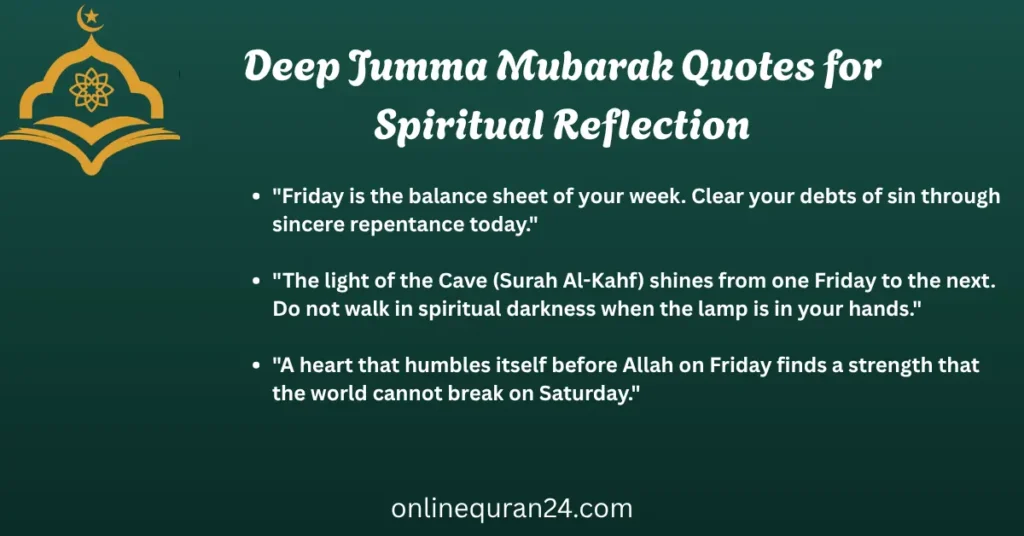
Reciting Surah Al-Kahf, the Quran’s 18th chapter, on Friday is one of the most consistently reported Sunnahs for the day. Multiple hadith — recorded by al-Hakim and al-Bayhaqi, and graded hasan (sound) by scholars including Ibn Hajar — describe a light that stays with the reciter from one Friday to the next.
The surah’s 110 verses cover four stories that scholars often summarize as four trials: the People of the Cave (a trial of faith), the man with two gardens (a trial of wealth), Musa and al-Khidr (a trial of knowledge), and Dhul-Qarnayn (a trial of power). Separately, Sahih Muslim reports that memorizing the first ten verses offers protection from the trial of the Dajjal — a detail many families use as a memorization goal for older children.
The recommended window runs from Thursday evening after Maghrib through Friday, so there’s no need to squeeze it into one narrow slot.
The Hour When Dua Is Accepted
Sahih al-Bukhari and Sahih Muslim both report that Friday contains a specific, brief hour in which a Muslim’s sincere prayer for something good is answered. Scholars differ slightly on exactly when it falls — the majority view places it between Asr and Maghrib, while another narration points to the time between when the imam begins the khutbah and the end of the prayer. Either way, the guidance is the same: use that window to ask directly, in your own words, rather than waiting for a specific fixed wording.
Beautiful Jumma Mubarak Quotes in English
Whether you want something short and simple or a few more special Jumma Mubarak quotes for someone specific, these cover a range of tones — good as a caption, a status, or a quick message to someone you care about:
- “Jumma Mubarak. May this Friday bring more light to your heart than it takes away.”
- “A blessed Friday isn’t just a message you send — it’s a prayer you actually make.”
- “May your prayer be long, your dua sincere, and your Friday full of barakah.”
- “Jumma Mubarak to a heart that finds rest in remembrance.”
Deep Jumma Mubarak Quotes
- “Every Friday is a fresh chance to return, to forgive, and to be forgiven.”
- “May Allah accept your Jumu’ah and answer the dua you haven’t said out loud yet.”
- “Jumma Mubarak Quotes — may this week end in gratitude and the next begin in mercy.”
Heart Touching Deep Jumma Mubarak Quotes
For someone going through a hard week, these sit a little closer to the heart:
- “Jumma Mubarak. If this week was heavy, let today’s dua carry some of it for you.”
- “May the same hands that make dua for others finally make one for yourself today.”
New Jumma Mubarak Quotes for 2026
- “New year, same blessed Friday — Jumma Mubarak Quotes, may 2026 keep meeting you at your best.”
- “Jumma Mubarak. May this year’s Fridays teach you more than last year’s did.”
Whichever style you send — a short one for a group chat or a longer, more personal line for family — a Friday message someone actually reads twice usually pairs a nice line with something specific to them.
Islamic Jumma Mubarak Quotes (Rooted in Quran and Hadith)
Unlike general well-wishes, these reflect specific teachings rather than just sentiment:
- The Quran instructs believers to hasten to the remembrance of Allah and set aside business once the call for Friday prayer is made (Surah Al-Jumu’ah, 62:9) — a reminder that presence matters more than punctuality alone.
- The five daily prayers and one Jumu’ah to the next are described as wiping out the sins committed between them, so long as major sins are avoided (Sahih Muslim).
- “There is an hour on Friday in which a Muslim, if he asks Allah for something good, will be given it” (Sahih al-Bukhari, Sahih Muslim) — a reminder to ask, not just to greet.
Jumma Mubarak Duas for Forgiveness, Rizq, and Peace
There isn’t one single fixed wording prescribed for the Friday hour of acceptance — the Sunnah is simply to ask sincerely, in your own words, for anything good. That said, these are commonly recited in that window:
- For forgiveness: “Astaghfirullah” (I seek Allah’s forgiveness), repeated with real reflection rather than as a routine phrase.
- For provision (rizq): Many Muslims ask directly for lawful, sufficient rizq for themselves and their family — there’s no single required Arabic formula, just sincerity in the request.
- For peace and ease: A short, personal dua for calm, for family relationships, or for a specific worry works better here than a borrowed script.
- Entering the mosque: “Allahumma iftah li abwaba rahmatik” — O Allah, open the doors of Your mercy for me (Sahih Muslim).
- Leaving the mosque: “Allahumma inni as’aluka min fadlik” — O Allah, I ask You from Your bounty (Sahih Muslim).
- Salawat: “Allahumma salli ala Muhammad” — sending blessings on the Prophet ﷺ, especially recommended in abundance on Fridays.
Jumma Mubarak Quotes in Urdu
جمعہ مبارک، آپ کا دن دعاؤں سے بھرا ہو۔
(Jumma Mubarak, may your day be filled with accepted duas.)
ہر جمعہ ایک نئی شروعات ہے، اللہ سے معافی مانگ کر آگے بڑھیں۔
(Every Friday is a new beginning — move forward by seeking Allah’s forgiveness.)
جمعہ کا دن رحمتوں کا دن ہے، اسے غفلت میں مت گزاریں۔
(Friday is a day of mercy — don’t let it pass by unnoticed.)
آپ کی نماز قبول ہو، آپ کا جمعہ مبارک ہو۔
(May your prayer be accepted, and your Friday blessed.)
Jumma Mubarak Shayari and Islamic Poetry
سجدے میں سر جھکے تو دل بھی جھک جاتا ہے،
جمعہ کا دن ہر گناہ دھو دیتا ہے۔
(When the head bows in prostration, the heart bows too — Friday washes away every sin.)
خاموشی خطبے کی برکت لے آئے،
دعا کی گھڑی دل کی مراد سنوارے۔
(Silence during the sermon brings its own blessing — the hour of dua sets right the heart’s longing.)
Short Jumma Mubarak Quotes for WhatsApp Status
- “Jumma Mubarak. Go make dua.”
- “Blessed Friday. Read Al-Kahf today.”
- “Happy Friday — the real kind.”
- “Jumma Mubarak to you and yours.”
- “May today’s dua be the one that changes everything.”
- “Friday: the day forgiveness has your name on it.”
- “Jumma Mubarak. Slow down, it’s Friday.”
- “A blessed Friday to a blessed you.”
Friday Beautiful Jumma Mubarak Quotes
These lean on the day itself rather than the person receiving them:
- “There’s something different about a Friday morning — quieter, calmer, closer to something bigger.”
- “A beautiful Friday isn’t the weather — it’s the mosque filling up before the adhan even finishes.”
- “Jumma Mubarak. The most beautiful part of Friday isn’t seen, it’s felt in the sujood.”
Special Jumma Mubarak Quotes
For someone specific — a parent, a spouse, a close friend — rather than a general group message:
- “Jumma Mubarak to someone who makes even an ordinary Friday feel special.”
- “Some duas are for everyone, and some are just for you — Jumma Mubarak, this one’s yours.”
- “You don’t need a big reason for a Jumma Mubarak just for someone special — today is enough of one.”
Unique Jumma Mubarak Duas: Moving Beyond the Basics
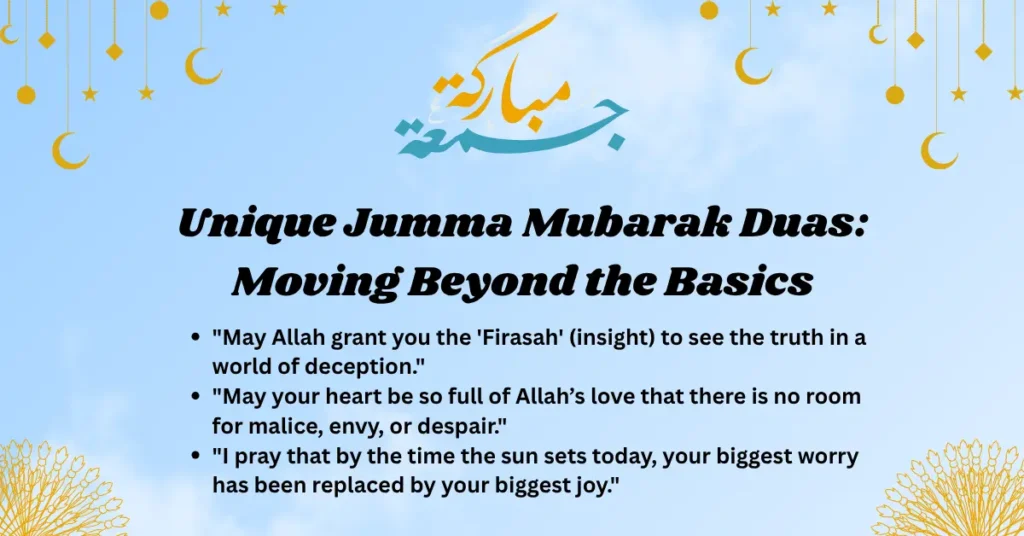
Most people send the same three messages. To stand out and provide real value, try these unique supplications:
“May Allah grant you the ‘Firasah’ (insight) to see the truth in a world of deception.”
“May your heart be so full of Allah’s love that there is no room for malice, envy, or despair.”
“I pray that by the time the sun sets today, your biggest worry has been replaced by your biggest joy.”
Jumma Mubarak in Arabic and How to Reply
Written in Arabic, the phrase is جمعة مباركة (Jumu’ah Mubarakah). If someone greets you this way, the simplest response is to repeat it back, or reply with بارك الله فيك (Barak Allahu feek) — “may Allah bless you.” Both are used interchangeably across Arabic-speaking and non-Arabic-speaking Muslim communities alike.
Expert Tips: Maximizing the Barakah of Friday
| Category | Recommended Action | Spiritual Benefit |
| Recitation | Surah Al-Kahf | Light for the entire week |
| Salawat | 100+ times | Proximity to the Prophet (PBUH) |
| Charity | Small secret act | Multiplied rewards |
| Social | Sending a Quote | Sadaqah Jariyah (Ongoing charity) |
The "How-To" of Sharing Quotes Effectively
Why do we share these? It’s not about likes; it’s about Tadhkir (remembrance).
Timing is Everything: Send your messages early in the morning or just before the Jumu’ah prayer.
Visuals Matter: Use clean, minimalist backgrounds. Avoid overly cluttered images that distract from the sacred text.
Be Sincere: Before sending a “Jumma Mubarak Quotes” message, take a moment to actually make that Dua for the recipient.
Heartwarming Jumma Mubarak Messages for the Modern Believer
As we navigate 2026, the challenges of digital burnout and global instability are real. Our messages should offer a sanctuary.
“Let your prayer mat be the place where you leave all your heavy burdens. Allah is ready to carry them for you.”
“The beauty of Friday is that it reminds us that no matter how bad the week was, we have a fresh start with our Lord.”
Teaching Children What Jumma Mubarak Really Means
For parents, Friday is a natural weekly teaching moment rather than just a greeting to explain once. A child who’s already working through Noorani Qaida can practice the letters and sounds that show up in Surah Al-Kahf. A child further along in Quran memorization can take on its first ten verses as a standing weekly goal. And a short conversation about what a dua actually is — not a magic phrase, but a direct, personal ask — does more for a child’s understanding than any quote card will.
This is where a structured, one-to-one class helps more than a general reminder at home. At Online Quran 24, children learn Noorani Qaida, Quran memorization, the meaning of everyday duas, and simple tafseer through live online sessions built around their pace, not a fixed classroom schedule — useful for families in the US, UK, Canada, Australia, and the Gulf trying to fit consistent Quran learning around school and family life.
In Short
A Jumma Mubarak message takes five seconds to send. What it’s pointing to takes a little more — a bath, clean clothes, an early walk to the mosque, real silence during the sermon, a surah read with attention, and a dua asked for like it matters. Send the quote if you’d like. Just don’t let it be the only thing you do with the day.
If you’re raising children who you want to actually understand Fridays this way — not just repeat the greeting — a live, one-to-one class focused on Quran reading, memorization, and everyday duas tends to make that stick far better than a reminder at home. You can see how that works at Online Quran 24.
FAQs About Jumma Mubarak Quotes
Hadith describe the reciter being granted a light that lasts from one Friday to the next, and Sahih Muslim links memorizing its first ten verses to protection from the trial of the Dajjal. Its four stories also serve as a guide through the trials of faith, wealth, knowledge, and power.
Both are correct. “Jumu’ah” is the formal Arabic transliteration, while “Jumma” is the more common phonetic spelling used in the Indian subcontinent and across many non-Arab Muslim communities.
“Jumma Mubarak” itself is a greeting, not a formal dua. What Islam actually describes is an hour on Friday — generally understood to fall between Asr and Maghrib — when a sincere prayer for something good is expected to be answered (Sahih al-Bukhari, Sahih Muslim). There’s no single required wording; the guidance is to ask Allah directly and specifically.
Two things stand out in the Sunnah: listening to the khutbah in complete silence, since even quiet talking during it is discouraged, and completing the two-rak’ah Jumu’ah prayer that replaces that day’s Dhuhr prayer. Arriving early enough to hear the khutbah clearly is also emphasized.
There’s no single “correct” one — the most meaningful messages are short, sincere, and pair the greeting with an actual dua for the person, such as wishing them an accepted prayer, rather than the phrase alone.
Repeat it back, or reply with “Barak Allahu feek” (may Allah bless you).
- Beautiful Jumma Mubarak Quotes In English
- Deep Jumma Mubarak Quotes
- Friday Beautiful Jumma Mubarak Quotes for Family
- Heartwarming Jumma Mubarak Messages
- Islamic Jumma Mubarak Quotes
- Jumma Mubarak Duas for Forgiveness
- Jumma Mubarak Duas for Forgiveness Rizq and Peace
- Jumma Mubarak Quotes
- Jumma Mubarak Quotes in Urdu
- Jumma Mubarak Shayari and Islamic Poetry
- jummah mubarak quotes
- New Jumma Mubarak Quotes
- Special Jumma Mubarak Quotes for Loved Ones
- Unique Jumma Mubarak Duas